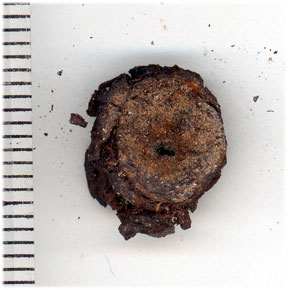
Monday, August 8, 2016

The Lady and the Lake: Joe Cerniglia's Analysis of a Vial from the Colonial Village Site at Ritiati, Nikumaroro

The Lady and the Lake
by Joe Cerniglia

Editor's Preface: Another artifact analysis by one of TIGHAR's most redoubtable researchers. 

Please note the continuing need for data on pharmaceutical bottles from Australia and New Zealand. Finding a clear Antipodal match for the vial that Joe describes would be the simplest and surest way to disqualify it as an Ameliafact.  TFK

During the 2015 “In Search of Amelia Earhart” trip to Nikumaroro, organized by Betchart Expeditions, Kimberly Zimmerman spotted an amber medicine vial, resting on the ground among other glass vessels near the colonial village’s fallen co-operative store. The vial measures roughly 10 by 2 centimeters and has a flute-edged cap apparently made of aluminum. The cap has been punctured in the center as though with a sharp object. Both the cap and the base of the vial have machine-made markings. Since glass vessels in the village are assumed to be associated with the Nikumaroro colony, active from 1939 to 1963, we decided not to bring the vial back with us, but we took photographs. Since then, we have become interested in some of the vial’s attributes. We plan to retrieve this artifact when we return to the island in 2017.

Fig. 1: the amber vial

While the vial awaits recovery, the photographs we took provided some data to consider. We began by looking at the circular inscription on the top of the vial’s cap.


The Inscription on the Cap

We were struck by this inscription, which, on account of time and wear, is mostly illegible, save for a few consecutive letters: UCA | PHARM[1]

Fig. 2: The top of the cap

Since available literature supports the idea that amber vials were most commonly used for medicines,[2] it would seem safe to presume that the second word on the top of the cap is “Pharmacy.”

The word before “Pharmacy” is more problematic, since only 3 terminal letters, UCA, remain. Presumably, it represents the name of the pharmacy in which the vial was filled and capped.

While pondering this inscription, we noticed the intriguing coincidence between those three letters “UCA” and the fact that Earhart resided in Toluca Lake from early November 1934[3] until taking off from Oakland, California for what became her last flight on May 20, 1937. Her first home in Toluca Lake was a rented cottage on 10515 Valley Spring Lane. She and George Putnam moved into their last residence in the neighborhood on 10042 Valley Spring Lane on September 21, 1935.[4]

Additionally, we recalled the many other glass vessels found in various locales on the island that might have come from an American pharmacy[5], many of which are not easily placed in the context of a remote Pacific island inhabited by Tuvaluan and Gilbertese colonists (but which might be placed in the context of the U.S. Coast Guard Loran Station that operated on the southern tip of the island from 1944 to 1946). We have spent considerable time studying these other apparently pharmacy-based vessels.

There was no telling yet if the vial had come from an American pharmacy, and perhaps the Toluca Lake association was coincidental, but it would have been hasty to conclude this before setting out to discover what “UCA PHARM” may have meant, and how old the vial may have been.


Exploring Village Suppliers

The vial was found, again, on the site of the abandoned village colony. We know that the colony was supplied at various times by an Australian firm, On Chong & Company of Sydney.[6] The idea that the vial was supplied by an Australian pharmacy with the letters UCA at the end of a word in its business name was therefore a lead we definitely wished to pursue.

Unfortunately, we were unable to locate any historical directories of pharmacies in Australia. An exhaustive check of Australian sources of the vial was therefore not possible. However, we were able to locate a database of all present-day cities and towns on Earth, which included the names of locales whose names end in UCA, in Australia and elsewhere, thus suggesting pharmacies adopting those names.[7]

This world database showed there is only one town in Australia whose last three letters end in UCA: Echuca. An online search of present-day pharmacies in Echuca showed that there is an Echuca Amcal Pharmacy in business there. We received no reply from a letter we wrote to Echuca Amcal Pharmacy inquiring whether it had ever seen the amber vial, so our inquiries into possible Australian connections to the vial appear to have reached an impasse. We lack the data at present to investigate more thoroughly.

The relative proximity of Nikumaroro to New Zealand and the fact that the island colony was a British possession would argue for New Zealand and the United Kingdom as the next likely sources of origin for a vial found in the village. Again, however, we were unable to locate any historical directories of pharmacies in these locales. We did find, perhaps tellingly, that the world database showed there are no cities or towns in either of these countries whose names, or words within their names, end in the letters UCA.


Exploring American Leads

On the other hand, at least in the U.S., there was much more data at hand to collect and to analyze. A complete yearbook of U.S. drug stores in operation has been available since 1912 through an annual publication known as the Hayes Druggist Directory. From a detailed study of available Hayes Directories[8] and online pharmacy directories from 1922 to 2015, we created a database spreadsheet of all pharmacies in the U.S. whose business name, city, or street address has the letters UCA at the end of a word.[9] Each pharmacy that satisfied these criteria was placed at the head of its own column on this spreadsheet. The rows of the spreadsheet represent the calendar years 1922 to 2015, inclusive. If the pharmacy was in business for the year represented by a row, then a numeral was placed in the cell in which that calendar year (row) and that pharmacy (column) intersect. The numeral in relevant cells of the spreadsheet represents a “commercial strength” score of between 1 and 90, which is a rough comparator of the worth of inventory-on-hand of each pharmacy in each year it was in business, as computed by Hayes.[10]

Fig. 3: Hayes Directories on a table at the Chemical Heritage Foundation, Philadelphia Pennsylvania
Fig. 4: Hayes Directory key for commercial strength
By summing the commercial strength scores for each pharmacy in each column, a final score was computed for each pharmacy’s commercial strength for all the years it was in business from 1922 to 2015. By dividing each pharmacy’s final commercial strength score by the sum total of all the pharmacies’ scores, the relative proportional contribution of each pharmacy to the total commercial strength of the “UCA pharmacy market” was obtained as a percentage.

From this survey of directories we discovered:

·         Overall, U.S. pharmacies with UCA at the end of the business name, street address or city are rare. Only 26 were located in a 94-year period. There were six that were in business last year. Given that there were 60,276 pharmacies operating in the United States last year,[11] this means that roughly .01% (1 in 10,000) of the total U.S. pharmacies last year satisfied the criteria for inclusion in this analysis.

·         41% of the UCA pharmacies’ total commercial strength scores come from a single pharmacy in Amelia Earhart’s neighborhood, the Toluca Lake district of North Hollywood, California. This pharmacy was for most of its long history (1936-1991) known officially as the “Lakeside Pharmacy in Toluca Lake, North Hollywood,” but there was a brief period (1937-38) when it was listed in the San Fernando Valley City Directory simply as “Toluca Lake Pharmacy.”[12]

·         62% of the UCA pharmacies’ total commercial strength scores come from nine pharmacies, all with the word ‘Toluca’ in their name, within 3.1 miles of the Toluca Lake district, in North Hollywood, Studio City, and Burbank, California.

·         When the sample size is adjusted, such that only pharmacies with names ending in UCA are included in the database, discarding pharmacies occupying streets or cities whose names end in UCA, 88% of the remaining UCA pharmacies’ total commercial strength scores come from nine pharmacies within 3.1 miles of the Toluca Lake district of North Hollywood, Studio City, and Burbank, California.

We do not know whether Amelia Earhart was a customer of the Toluca Lake Pharmacy, much less whether she bought anything in vials there, but in three letters Earhart wrote to her mother before the world flight, she mentions a “vegetable concentrate” pharmacy elixir, telling of the benefits her husband, George Putnam, derived from taking it, and urging her mother, sister, niece and nephew to try some.[13] In one of the letters she states that a “Dr. Friend,”[14] would be willing to “make up a concentrate suitable for individual needs.” Vegetable and fruit concentrates often sold in vials, and still do today, as in the photo below.

Fig. 5: Modern fruit concentrate vials
Both of Earhart’s residences in Toluca Lake were between .7 and .8 miles of Toluca Lake Pharmacy. There was no pharmacy nearer by. The next nearest pharmacy to Earhart’s neighborhood in 1937 was W.D. Roberts Drugs, which was 1.4 miles distant.[15]

None of the research thus far, however, had attempted to answer the question of whether the vial was even old enough to have been brought to the island by Amelia Earhart, or whether it could be ruled out from having been brought by Earhart on account of its presumed age. To begin to answer this question, we turned our attention to the markings on the vial’s base.


Marks of Distinction?

Base markings can often identify a bottle’s manufacturer, the year in which a bottle was made, or a range of years in which a bottle could have been made.

On the base of the vial, there is a numeral 2 to the left of an unidentified central mark, and a numeral 0 to the right of it, along with a letter code, NT, centered below the mark.

Fig. 6: The base of the vial
The Society for Historical Archaeology’s Bottle Research Group[16] (a group that helps archaeologists and others identify bottles) and members of the Australian Antique Bottle Forum[17] examined these marks. Neither group was able to match the marks to any glass trademark they had seen or could reference.

The markings, however, share features with what the Owens-Illinois Glass Company used on its bottle bases from 1929 to 1954, as shown in the following photos:

Fig. 7: Toulouse (1971) illustration of OI mark with key explaining the meaning of the numerals[18]
Fig. 8: Compared vials
The green vial base on the left side of the above photo has the first Owens-Illinois trademark, "I" within a diamond over an oval, used from 1929 to 1954. The base of the amber vial found on Nikumaroro, on the right side of the above photo, has a letter "I" nested between brackets. Both vials have the same triadic arrangement of codes to the left, right, and beneath the mark. The Nikumaroro vial, however, lacks a central oval, shown in red, which, if it were present, would have heightened its resemblance to the Owens-Illinois base mark.

One way to explain the discrepancy relates to quality control problems. Glass factories used a lubricant called dope to prevent bottles from sticking to their molds. If a plant failed to clean the molds, whether from pressure to meet deadlines or simple oversight, the dope deteriorated and built up on the surface, so that letters or numbers on the finished bottle could be obscured or become very faint.[19] If degraded dope did build up on the mold that made the vial, it could have obscured the trademark of the Owens-Illinois Glass Company (or another company).

However, it goes without saying that facts, not hypotheses, are needed to identify a bottle mark conclusively. The only marks that can offer facts are those that are present, not those that may or may not be absent. Thus, although we hoped to learn the vial’s maker or its manufacture date, the markings on the base of the vial were simply too obscure to yield this information with certainty.


The Cap of the Vial: Datable Features?

We then turned our attention to the cap on the vial (excluding the inscription, which has already been discussed) in the hope that it would provide answers to our questions about when and where the vial was made. Three noteworthy features suggest the cap is of the roll-on variety, distinct from the far more common pre-threaded caps:

1)      The cap is conformed tightly to the vial such that it could not easily be removed.

Roll-on caps were, and are, “pressed in the capping machine by rotating rollers and shaped to conform with the individual bottle’s threads.”[20] While one cannot discount the possibility the cap is misshapen from repeated use, or originated from a container other than the vial itself, poor fit was a common complaint of caps in general in the early 1930s.[21] R-O caps specifically were known to stick because defects in the threads of the finish could cause the cap to be “drawn into the defect, locking the cap on and making it very difficult for the consumer to remove.”[22]

2)      The cap is made of heavy gauge metal, probably aluminum, and is not rusted. It has no outwardly rolled distal wire edge, as would be common on ordinary pre-threaded screw caps.

The Aluminum Seal Company (Alseco), a subsidiary[23] of the Aluminum Company of America (Alcoa) of New Kensington, Pennsylvania, first introduced roll-on caps, also known as R-O, in 1924. R-O caps were “initially used” in the early years after 1924 “for prescription drugs and later in some vapor-vacuum sealed caps for foods.”[24] While not all aluminum caps are R-O caps, it would appear that all R-O caps are aluminum, due to aluminum’s excellent malleability.[25] They can be found today on liquor bottles and some condiments, such as olive oil.[26]

3)      The cap has a rectangular tab-like indentation a few millimeters wide on the lower part of its skirt, in which the metal appears to have been broken off from the cap.

The rectangular indentation, visible in the lower right corner of the cap on the amber vial in the photo below, could be a remnant of a tamper-proof seal patented in 1933 by Alcoa specifically for R-O closures.[27] The seal was pressed around the base of the cap during the production process of crimping the cap with rollers. One removed the seal by pulling up on a tab. Once removed, a portion of the depending metal skirt could be deformed or torn away.

Fig. 9: Amber vial and 1936 Seagram's advertisement for pilfer-proof R-O cap

Fig. 10: Amber vial and close-up of Seagram's advertisement
In summary, then, we have:

·         The poorly fitting aluminum cap, probably R-O, introduced in 1924 by Alseco, and
·         The rectangular tab of missing cap material, possibly representing a pilfer-proof seal patented in 1933 by Alcoa, parent of Alseco.

If we are interpreting these features correctly, they could indicate the cap was made between 1924 and the mid-1930s.

The cap could also have been made at a later time, however, since the use of R-O seals on drug containers continued long past the 1930s. Although aluminum closures “seem to have been banned altogether” during World War II,[28] and despite aluminum shortages during the Korean War (1950-53),[29] R-O caps on drug bottles were marketed in the 1950s and 1960s, and “might yet be in use in Central America.”[30] These later R-O caps are described in trade literature as having a “locking band attached to the cap by small metal bridges… (The locking band) remains on the bottle after the cap is removed.”[31] One can easily locate this type of R-O cap today on condiments sold in supermarkets.

While the Nikumaroro vial does not have a persisting locking band, such a band could have been removed from the cap during its history.

In general, however, R-O aluminum closures on medicine containers appear to have been very rare. We surveyed hundreds of medicine vials and pill bottles at auction on eBay and Etsy.com. With one exception, all the caps on these containers, dated from 1932 to 2003, appeared to be pre-threaded, not roll-on. A very small number appeared to be aluminum, but the vast majority appeared to be tinplate or Bakelite. We obtained a sample of these containers at auction. All the caps on the bottles from this sample were easily removed.[32]

The only medicine bottle we found, in addition to the vial itself, that appears to have an aluminum R-O cap was a bottle of topical cocaine ointment, pictured below. The bottle has the locking band as described in postwar trade journals, and a paper label dated February 2003.

Fig. 11: Cocaine hydrochloride bottle with R-O cap
We have been seeking but lack data concerning when R-O closures were used on drug containers in countries other than the United States. It could be that the absence of data indicates this type of cap was seldom or never used on drug containers elsewhere in the world, but we cannot say for sure.


A Knurly Problem

Experts from the Bottle Research Group have identified one feature of the vial, however, that causes them to say it is definitely not from the 1930s and thus could not possibly be Earhart’s. They say the little tooth-like marks on the perimeter of the base are datable to the 1950s or later.

Fig. 12: Perimeter knurling on base of the vial
The tooth-like marks are an example of what is known as resting point knurling, defined as marks impressed by machine to the bottle mold, which in turn create marks on the perimeter (the resting point) of a slightly concave bottle base. According to Russ Hoenig, a former Owens-Illinois shop foreman, these marks offered protection to the glass against cracking. These and other like marks “became a necessity as bottles were light-weighted with thinner glass. The cold checks (cracks) present on all bottles formed prior to annealing now penetrated proportionately deeper through the glass wall thickness on lightweight flow-manufactured bottles, which caused breakage.”[33]

The earliest documented date assigned to resting point knurling of the type exhibited on the Nikumaroro medicine vial is 1958. Coincidentally, that date is based on another Nikumaroro glass vessel, a green beverage container upturned as a grave marker on the western shore of the island, a few hundred meters north of the landing channel (editor's note: the Ritiati Bottle Grave, recorded in 1997 and again in 2015, now heavily eroded). That bottle has a date code of “58” to the right of the second Owens-Illinois trademark, which first appeared on bottles in 1954.

Fig. 13: Green beverage bottle in grave on western shore of Nikumaroro
Base markings used to prevent cracking could, as in the case of the amber vial, surround the perimeter of a bottle base, but much more often they covered the entire base. Where such marks were impressed on the mold’s base plate by machine, they are called full base knurling. Where such marks were impressed on the mold’s base plate by hand, they are called full base stippling. According to the Bottle Research Group, full base knurling by machine first appeared in 1945, and full base stippling by hand first appeared in general use in 1940.[34] [35]

However, the timeline constructed by the Bottle Research Group may not be perfect. There is evidence that full base stippling by hand appeared on select drug containers as early as 1932.


Antidotes

We have located two identically designed “Abbott Lab” pill bottles in amber with full base hand stippling, identical base markings (including the same plant number and year code), and identical prescription wraparound labels.

Fig. 14: Twin pill bottles
Fig. 15: The base of one of the Abbott Lab pill bottles
The label on one of the bottles has been sunned to the point that most of the printing is no longer legible. The label on the other is legible, but the typewritten year of its prescription date is slightly faded. To help determine exactly what the year on the label of this bottle is, we consulted a board-certified document examiner. Emily Will, D-BFDE (http://qdewill.com), stated her professional opinion, based on rigorously certified techniques, that the year of the label’s prescription date is 1934.[36]

On the base of the bottle with the dated label, the embossed year-of-manufacture code, situated to the right of the first Owens-Illinois trademark (used from 1929 to 1954), is a 2. This represents a year ending in the numeral 2. We presume that the bottle was manufactured in the year of the prescription date on the label, or in a prior year, such that the bottle’s year of manufacture must be earlier than or equal to 1934. The only calendar year between 1929 and 1954 that ends in 2 and is earlier than or equal to 1934 is 1932. Therefore, it is reasonable to presume this bottle with full base stippling and a dated paper label was manufactured in 1932.

We have located another amber medicine bottle, also with full base stippling. This bottle’s design is patented, as indicated by a patent number, 94824, stamped on the base. The U.S. Patent Office approved the patent in 1935.[37] The plant number, situated on the base to the left of the first Owens-Illinois mark (1929-1954), is Owens-Illinois plant number 4, Clarksburg, West Virginia, which went idle in 1944.[38] The year-of-manufacture code, situated on the base to the right of the mark, is a 9, which signifies a year ending in the numeral 9. Based on the Clarksburg plant’s years of operation, the bottle cannot be dated to 1949. Based on the patent date, it cannot be dated to 1929. Therefore, the bottle is dated with certainty to 1939, a year prior to the earliest previously documented example of full base stippling.

Fig. 16: Base of 1939 amber medicine bottle
While we have yet seen no glass container earlier than 1958 with the same resting point knurling as found on the Nikumaroro vial, the pill bottle and the patented amber bottle demonstrate that no dating system is perfect. Careful research may occasionally uncover exceptions to any archaeological dating rule. The Bottle Research Group looked closely at beer and soda bottles for relevant examples when it constructed its timeline, but it appears that it did not inspect medicine containers.[39]


An Amelia-fact?

Since full base stippling was first used on some medicine containers a few years before beer and soda, it may be that perimeter knurling followed a like pattern, first appearing on select medicines in the 1930s and then later on beverages in the 1940s once it was needed for the lighter weight bottles. We do not know whether these speculations are true, but they are logical. If they are true, and if the vial really is from the U.S., then Amelia Earhart just may have brought the vial from Toluca Lake Pharmacy to the island. At least the possibility should not be ruled out. But we have other caveats, such as:

·       If the vial was Earhart’s, it likely took a circuitous route to the village, which is “not where we are likely to find Earhart-related objects in their original contexts.”[40] Instead, it was likely brought there from somewhere else.

·       We do not know the full list of pharmacies in the world whose name, street, or city end in UCA, but, as has been stated, we do know that the colony was supplied by an Australian firm, which could easily be a source of pharmaceutical vials.

·       We know that at least five Coast Guardsmen at the Loran Station on Nikumaroro between 1944 and 1946 lived before the war in U.S. cities or towns that were within driving distance (1 to 100 miles) of several towns with pharmacies in the database of UCA pharmacies.[41]


Conclusions and Questions

Some of the Nikumaroro artifacts fascinate because they may be of a certain time, the 1930s, or of a certain person, a castaway. The amber vial fascinates because, although it is not proven to be, it just might be of a certain place, a little village in California that once counted Amelia Earhart among its own – along with a friendly drug store, named Toluca.[42]

Since the island, however, had its own village, and a history of colonists, Coast Guardsmen, explorers, researchers and others, who doubtless used medicines, there exist other equally or more equally plausible ideas as to the amber vial’s provenance. We have ideas, but few definitive answers.

Nevertheless, there are some questions that might be answerable, definitively we hope, through further research, to which anyone is welcome to contribute:

1. Have you seen the markings found on the bottom of the vial on other glass vessels? Can you say what they mean?

2. Can you locate any of the following at auction, antique shops or archaeological sites?

·         R-O closures on medicine containers
·         Medicine containers with resting point knurling
·         Base-stippled medicine containers whose manufacture date is from the 1930s
·         Toluca Lake Pharmacy vials

3. Do you know of other pharmacies outside the U.S., in Australia or elsewhere, with names ending in “UCA”? Do you know of any we missed inside the U.S.?

We also have some questions that might be answerable by those intrepid researchers fortunate enough to be on the next cruise to Nikumaroro in 2017:

A. What types of medicine containers (vials, pill bottles, etc.) can be found near the village dispensary and elsewhere in the village?

B. Can the amber vial be located again, recorded for its context and associations, and retrieved for further analysis? If so, what tests might bring back the most relevant data?

Research will continue on these questions and, very likely and in keeping with the nature of a mystery, many more that we have not yet thought to ask.


Selected Bibliography


Backus, Jean L. Letters From Amelia: An Intimate Portrait of Amelia Earhart. Boston: Beacon Press, 1982.

Bender, Nathan E. Historic Bottle and Jar Closures. Walnut Creek, CA: Left Coast Press, 2016.

Giles, Geoff A. Handbook of Beverage Packaging. Boca Raton: Taylor & Francis, 1999.

Griffenhagen, George and Bogard, Mary. History of Drug Containers and Their Labels. Madison, WI: American Institute of the History of Pharmacy, 1999.

Hanlon, Joseph F., Kelsey, Robert J., Forcinio, Hallie. Handbook of Package Engineering, Third Edition. Boca Raton: CRC Press, 1998.

Lief, Alfred. A Close-Up of Closures: History and Progress. New York: Glass Container Manufacturers Institute, 1965.

Osborn, Albert S. Questioned Documents, Second Edition. Albany: Boyd Printing, 1950.

Peterson, Arthur G. 400 Trademarks On Glass. DeBary, Florida: Arthur G.Peterson, 1968.

Sonnedecker, Glenn; Cowen, David L.; Higby, Gregory J., eds. Drugstore Memories: American Pharmacists Recall Life Behind the Counter, 1824-1933. Madison, WI: American Institute of the History of Pharmacy, 2002.

Toulouse, Julian Harrison. Bottle Makers and Their Marks. Caldwell, New Jersey: The Blackburn Press, 1971.

Winters, Kathleen C. Amelia Earhart: The Turbulent Life of an American Icon. New York: Macmillan, 2010.


For information on the Nikumaroro hypothesis concerning the 1937 disappearance of Amelia Earhart, see:

Gillespie, Richard. Finding Amelia. Annapolis: Naval Institute Press, 2006.

King, Thomas F., Jacobson, Randall S., Burns, Karen R., Spading, Kenton. Amelia Earhart’s Shoes. Lanham, MD: Altamira Press, 2004 (updated edition).

King, Thomas F., Thirteen Bones. Indianapolis: Dog Ear Publishing, 2009.


[1] We interpret the vertical line between “UCA” and “PHARM” as an interpunct, a word separator.
[2] Griffenhagen, George and Bogard, Mary. History of Drug Containers and Their Labels. Madison, WI: American Institute of the History of Pharmacy, 1999, pp. 35-36.
[3] Winters, Kathleen C. Amelia Earhart: The Turbulent Life of an American Icon. New York: Macmillan, 2010, pp. 151-152.
[4] Papers of Amy Otis Earhart, Arthur and Elizabeth Schlesinger Library, Radcliffe Institute for Advanced Study, Harvard University, Cambridge, Massachusetts. Call No. MC 398, M-129, Reel #3.
We are indebted to Sarah Hutcheon, Research Librarian at the Radcliffe Institute for Advanced Study, for her assistance.
[5] For a list of various containers of suspected pharmaceutical origin, see Dr. Thomas King’s blog at http://ameliaearhartarchaeology.blogspot.com/2016/06/2017-nikumaroro-draft-research-plan-i.html
[6] See http://tighar.org/Projects/Earhart/Archives/Documents/Tarawa_Archives/1939_Co-op_Store/1939store_3.pdf for details on the Gardner colony’s relationship with On Chong & Company.
[7] See https://www.maxmind.com/en/free-world-cities-database
[8] On November 23 and 24, 2015, The Chemical Heritage Foundation in Philadelphia, Pennsylvania generously opened up its collection of Hayes Directories for research purposes. We are indebted to librarian Ashley Augustyniak for her assistance.
[9] The pharmacy database may be viewed at https://www.dropbox.com/s/h34l05afr89gbbo/Pharmacy%20Database%20and%20Loran%2092%20Census.xls?dl=0
[10] For pharmacies in business after 1997, we were unable to access the relevant Hayes Directories. Instead, we used pharmacy directories available online from insurers. For these pharmacies, we estimated the commercial strength scores based on size of the market. For those years in the 20th century for which no Hayes Directory was available, we filled in missing data by using information from Hayes Directories from years prior to and later than the gap, when it was logical to do so.
[11] www.hayesdir.com/aboutus.html
[12] Yellow pages: San Fernando Valley Directory. 1937-38. Long Beach, CA: A to Z Directory Publishers.
See the Directory listing for Toluca Lake Pharmacy at
https://www.dropbox.com/s/rm8b6z4gva89obf/Photo%20Oct%2031%2C%201%2028%2042%20PM.png?dl=0. Note that this establishment is also listed elsewhere in the directory as “Lakeside Pharmacy.”
[13] Earhart, Amelia. Letters to Amy Otis Earhart. 5 July 1935; 25 Feb 1936; 20 Mar 1936. MS. Papers of Amy Otis Earhart, Arthur and Elizabeth Schlesinger Library, Radcliffe Institute for Advanced Study, Harvard University, Cambridge, Massachusetts.
[14] The chief pharmacist, owner and founder of Toluca Lake Pharmacy was Robert G. Eyth. Eyth is an Anglo-Saxon word that is loosely translated as “friendly.” The 1937-38 San Fernando Valley telephone directory lists no doctor by the name of “Friend.” In Letters from Amelia, a compilation of letters written by Earhart, editor Jean Backus chose to redact the name of Dr. Friend, instead referencing him or her as “the doctor.” She presumably did this to mask the doctor’s identity (for reasons unknown).
[15] Yellow pages: San Fernando Valley Directory. 1937-38. Long Beach, CA: A to Z Directory Publishers. Distances computed by mapquest.com.
[16] The Bottle Research Group consists of:
Bill Lockhart, Professor, New Mexico State University
Dr. Peter Schulz, Senior Archaeologist (retired), California State Parks, Sacramento, California
Carol Serr, Archaeologist, Laguna Mountain Environmental, Inc., San Diego, CA
Bernard Schriever, Archaeologist, Laguna Mountain Environmental Inc., San Diego, California
David Whitten, collector and glassmaking historian, Clarksville, Indiana
[17] www.ozbottleforum.com
[18] Toulouse, Julian Harrison. Bottle Makers and Their Marks. Caldwell, New Jersey: The Blackburn Press, 1971, p. 403. 
[19] Lockhart, Bill. “Re: Photo from Bottle Grave Site.” Message to Joe Cerniglia and Thomas King. 19 Dec 2015. E-mail.
[20] Lief, Alfred. A Close-Up of Closures: History and Progress. New York: Glass Container Manufacturers Institute, 1965, p. 29.
[21] Ibid., p. 33.
[22] Giles, p. 238.
[23] https://en.m.wikipedia.org/wiki/Alcoa
[24] Hanlon, Joseph F., Kelsey, Robert J., Forcinio, Hallie. Handbook of Package Engineering, Third Edition. Boca Raton: CRC Press, 1998, p. 436.
[25] Giles, Geoff A. Handbook of Beverage Packaging. Boca Raton: Taylor & Francis, 1999, p. 238.
[26] For a demonstration of the process of creating an R-O cap, see the video at www.fowlerproducts.com/videos/roll-on/
[27] To view the patent, see https://patentimages.storage.googleapis.com/pdfs/US1895884.pdf
[28] Bender, Nathan E. Historic Bottle and Jar Closures. Walnut Creek, CA: Left Coast Press, 2016, p. 90.
[29] U.S. Congress, Office of Technology Assessment, Technical Options for Conservation of Metals: Case Studies of Selected Metals and Products, OTA-ITC M97 (Washington, DC: U.S. Government Printing Office, September 1979), p. 118.
[30] Bender, pp. 84-86.
[31] Modern Packaging Encyclopedia, 1951 edition., Packaging Catalog Corporation, 1951, p. 456.
[32] For a database of medicine containers, see https://www.dropbox.com/s/yi66g54yi1g5wdu/medicine%20container%20survey.xls?dl=0
[33] Lockhart, Bill. “Re: The Boston Pill Bottle.” Message to Joe Cerniglia and Thomas King. 27 Jan 2016. E-mail.
[34] See https://sha.org/bottle/bases.htm
[35] Lockhart, Bill. “Re: The Boston Pill Bottle.” Message to Joe Cerniglia and Thomas King. 7 Dec 2015. E-mail.
[36] For Emily Will’s full forensic report, see https://www.dropbox.com/sh/zqp92wn8wb17xms/AABC2IouXb_YFz4sD6_wHGDva?dl=0. For a biographical timeline (source: Ancestry.com) of persons whose names appear on the label, see https://www.dropbox.com/s/d7fhc702fksm3ge/Photo%20Jul%2005%2C%2011%2005%2046%20AM.png?dl=0. The timeline demonstrates the label is internally consistent with the prescription date of 1934.
[37] http://www.google.com/patents/USD94824 and also https://www.sha.org/bottle/pdffiles/USD94824.pdf
[38] https://sha.org/bottle/pdffiles/O-IPlantList.pdf
[39] The archaeological site from which examples of bottles with stippling and knurling were obtained was the back lot of a former beer distributor in El Paso, Texas. Lockhart, Bill. “Re: The Boston Pill Bottle.” Message to Joe Cerniglia and Thomas King. 7 Feb 2016. E-mail.
[40] Thomas F. King, http://ameliaearhartarchaeology.blogspot.com/2016/06/2017-nikumaroro-draft-research-plan-i.html
[41] Using Ancestry.com, we compiled a census of all 71 men who inhabited Loran Unit 92 on Nikumaroro, to try to discover each man’s residence just prior to World War II. See the census at the second tab of the Excel document at https://www.dropbox.com/s/h34l05afr89gbbo/Pharmacy%20Database%20and%20Loran%2092%20Census.xls?dl=0. The personnel roster was sourced from www.loran-history.info/roster.aspx.
[42] For a circa 1959 tour of shops along Toluca Lake's main road, Riverside Drive, which includes a Toluca Pharmacy at 0:55, see http://youtu.be/3Rk1r6M0G8I

Friday, June 3, 2016

2017 Nikumaroro Draft Research Plan - I: The Colonial Village


Please see www.niku2017.com for information on the 2017 research cruise to Nikumaroro.

In consultation with my colleagues, I’m starting to cobble together plans for each component of the proposed research. I’ll be posting them as they’re developed, and updating them based on comments and rethinking. Please take a look, and give us the benefit of your thoughts.

Component 1: The Colonial Village
The site of the colonial village and government station, occupied from 1939 until 1963, is not where we are likely to find Earhart-related objects in their original contexts. On the other hand, it is precisely where we would expect such objects to be concentrated that were picked up by the colonists elsewhere on the island. This is why it is not surprising that we have found fragments of aircraft aluminum in the village and virtually nowhere else. It’s also why I regret failing to collect the small amber medicinal vial found in the village in 2015 by Joe Cerniglia and Kim Zimmerman, with cap and base markings that may identify it not only as American but as coming from a pharmacy close to Earhart’s home in California. Luckily Joe and Kim recorded it in detail[i], and we’ll try to relocate and recover it in 2017.
The village is also naturally where non-Earhart related objects are concentrated. So when we find something interesting elsewhere on the island and wonder whether someone other than Earhart and Noonan dropped it there, the best place to look for comparative examples is in the village.

One thing we are always interested in finding, obviously, is airplane parts, and the village is where we’ve found them.

We’ve also developed an increasing interest in medicine and cosmetic bottles, because we have evidence of them at the Seven Site and Shoe/Bivouac Site– of apparent U.S. origin and very likely dating to the 1930s[ii]. We know there are medicine/cosmetic bottles at the village site, too, but we haven’t looked at them carefully to see how they compare with the Seven Site examples. We assume that they’re mostly from New Zealand, Australia, or the UK, and that they mostly date from periods later than the ‘30s, but we don’t know that. So it would be useful to increase our comparative sample of such bottles. We collected some from the village’s “Cosmetic Site” in 2015; it would be helpful to collect some more.
 
Previous surveys have shown that bottles are thick on the ground in the neighborhood of what we’re pretty sure was the colonial dispensary, at the SW corner of the Government Station. So we plan to take a brief but concentrated look at the dispensary and collect a sample of bottles that appear to represent common types.

As for airplane parts, those we’ve found have mostly been on residential sites, where they were probably dropped in the course of transforming them into hair combs, fish lures, inlay for boxes, and the like. Residential sites are distributed mostly SE of the Government Station, an area that’s densely wooded in feral coconut and pandanus (producing a thick, obscuring mat of deadfall on the ground. So we’re planning a simple sweep with metal detectors of a swath starting at the dispensary and proceeding east to the lagoon beach, to see what may be detected. Anything that appears to be aircraft-related will be located using GPS and collected if feasible.


[i] Paper by Joe Cerniglia forthcoming
[ii] Medicine/cosmetic containers at locations other than the village include:
Seven Site
1.     Bottle shard with the word "Mennen" embossed on it, Matches those sold by Mennen for its Skin Bracer product and its Baby Oil product. Dates from roughly 1930 to 1950.  See page 3 of https://tighar.org/Publications/TTracks/2010Vol_26/1110.pdf

2.     Bottle for skin lotion, possibly privately compounded by a druggist.  Design patent on the bottle is American and dates to the 1930s but the bottle could have been manufactured later than the 1930s. (Updated paper pending).  

3.     Ointment jar that analysis suggests contained anti-freckle lotion. The maker of the bottle, Hazel-Atlas, stated that the majority of its ointment jars prior to 1930, and many after that time, were "druggist specialties."  The type of glass used in the jar does not seem to have been one used in mass production or wide commercial distribution.  See https://tighar.org/Projects/Earhart/Archives/Research/ResearchPapers/freckleintime/FreckleInTime.html

4.     Green bottle that appears to have contained either St. Joseph Liniment or Penetro Cough Syrup (both manufactured by Plough, Inc. of Memphis, Tennessee).  Plough products were commonly sold in drug stores.  See https://tighar.org/Projects/Earhart/Archives/Research/ResearchPapers/freckleintime/Document_20_Artifact2-8-S-27.pdf

Aukaraime Shoe/Bivouac Site

Container cap that, based on the painted logo on its surface, came from a bottle of Alka-Zane (antacid), Agarol (laxative), or Cal-Bis-Ma (anti-nausea), all manufactured by William R. Warner & Company of New York, starting in 1932.  See p. 134, Amelia Earhart's Shoes.  

Tuesday, May 24, 2016

Earhart’s First Aid Kits at the Seven Site? Well, Maybe

I was asked recently about whether we have evidence at the Seven Site on Nikumaroro of the first aid equipment carried by Earhart and Noonan aboard the Electra. Here’s what I know.

1.   The inventory taken after the Luke Field mishap that ended Earhart’s first World Flight attempt indicates that the Electra at that time carried two first aid kits:
a.    A “Bauer & Black No. 42” and
b.   A “Tabloid” produced by Burroughs, Wellcome & Co. (See http://tighar.org/Projects/Earhart/Archives/Documents/Luke_Field.html.)

2.   Bauer & Black No. 42 kits I’ve been able to find on the internet appear to be metal boxes, ca. 30-40 cm. on a side (See http://www.worthpoint.com/worthopedia/bauer-black-airplane-42-first-aid-kit-287930316)

3.   A possibly contemporary (but not Bauer & Black) kit acquired by Arthur Carty is a flat, square thin metal box some 33 cm. on a side (Figure 1).


Figure 1: Metal 1st Aid Box


5.   One “tabloid” box acquired by Art Carty is a rectangular, red-painted wooden box, 18x13.5x7 cm. in size, whose hinged top opens at the center and folds out. It contains bandages, including a tin of Band-Aids (invented in 1920; see http://www.band-aid.com/brand-heritage), tincture of iodine, a tourniquet, gauze, vials of iodine and Aminopylene, solidified Carron Oil for burns and scalds, Castor Oil for the eye, Protective Skin, and “Vaporole” (amyl nitrate, for angina) (Figures 2A&B).

 Figure 2A: "Tabloid" Kit
 Figure 2B: "Tabloid" Kit open. Note snap.


6.   One inside compartment on the “tabloid” box has a cover secured by a snap (Figure 2B).

7.   Next to the “SL” burn feature at the Seven Site, and also adjacent to Clambush 2, we documented a ca. 40x40 cm. rectangular deposit of thin ferrous metal, heavily oxidized and fragmented (Figures 3, 4). This appears to be about the same size as Art’s metal kit, and to represent a similar gauge metal, but it exhibits “bumps” (Figure 5) that I interpret as pins or rivets, which Art’s kit does not display.


Figure 3: Lonnie Schorer works on Clambush 2. Rectangular
ferrous deposit is midway down right side of the clam deposit


Figure 4: Schematic of SL Fire Feature, Clambush, & 
ca. 40. cm. ferrous deposit.


Figure 5: Example of ferrous fragment with "bump" suggesting
a pin or rivet, from unit SL-3


8.   The “WR” burn feature at the Seven Site (Figure 6) contained both halves of a snap (Figure 7) similar to the one on Art’s “tabloid” kit. It produced none of the other metal hardware found on the “tabloid,” however.

Figure 6: Schematic of "WR" Fire Feature


Figure 7: Snap from WR Fire Feature, Top: Male part; bottom: female part. Millimeter scale.

Do the artifacts recorded at the Seven Site represent Earhart’s First Aid Kits? Well, they might, but they might represent innumerable other things too, brought to the site by Earhart or Noonan, the colonists, USCG personnel from the Loran Station, or someone else.


Saturday, April 2, 2016

Update: 2017 Betchart Expeditions Trip to Nikumaroro

Nikumaroro is calling! Now's your chance to visit.

We now have a website dedicated to the 2017 Nikumaroro trip with Betchart Expeditions; it’s at www.niku2017.com. Please take a look.

We’re on track for the trip, but need to finalize the ship charter by this June, so need to be reasonably sure we’ll have a critical mass of passengers. So if you want to join us, please get your reservations and deposits in NOW. And please encourage friends and colleagues to do so, too.

Fundraising is underway to support the research part of the trip – without which it won’t be possible to do much more than wave at the island and contemplate what may have happened there to Earhart and Noonan. As you’ll see on the website, one way people can support the research is by “adopting an expert” – or a half or quarter of an expert, a couple of experts, or the whole team. Please consider helping, and encourage others to do this, too.

If Adopt-an-Expert works out, we’re considering doing something similar to support another team visit to Fiji, to pursue the elusive bones and sextant box, see if any leads can be developed on what happened to Gerald Gallagher’s effects, and pursue a couple of other leads. If you’re interested in this, please let me know.

All this is separate from the ongoing effort to raise funds for a deepwater search of Niku’s reef using manned submersibles. For information on that, please visit TIGHAR.org.

Questions, comments, brickbats – please contact me at tomking106@gmail.com or 01-240-475-0595.

Thanks -- Tom


"Club Fred," on the lagoon shore of the colonial village at Ritiati

Monday, December 21, 2015

2001 Report on the Seven Site

A bit of history -- I'm organizing my files to start serious work on a comprehensive report on Nikumaroro archaeology. For purposes of historical reference, I thought it might be useful to post this paper, written after the 2001 expedition to Nikumaroro. Of course, we've learned a lot about the Seven Site since this was written. And incidentally, we turned out to be wrong about the "Kanawa" at the Triangle Site; it's not Kanawa at all, but Island Walnut.

TK

SEARCH FOR THE NIKUMARORO CASTAWAY’S CAMP:
PRELIMINARY REPORT ON ARCHAEOLOGICAL INVESTIGATIONS
AT THE TRIANGLE SITE AND THE SEVEN SITE,
NIKUMARORO ISLAND, PHOENIX ISLANDS,
REPUBLIC OF KIRIBATI

Thomas F. King
September 22, 2001

Introduction


Gerald Gallagher, in his 1940-41 reports to the Western Pacific High Commission (WPHC), describes the discovery of a human skeleton and associated artifacts which he associated with Amelia Earhart on the “southeast corner” and “southeastern shore” of Nikumaroro (See King et al 2001:207-21 for details).  He says that the skeleton was lying under a Ren tree (Tournefortia)[1] and that it was associated with the remains of a fire and the bones of birds and turtle.  He says that the site was about “100 feet from high water ordinary springs.”  He reports that upon discovery (prior to his arrival on Nikumaroro), the cranium was buried; it was later exhumed at his direction.

The cranium, mandible, and eleven other bones found by Gallagher and his colleagues were sent to Fiji for analysis, where it was concluded (perhaps incorrectly, according to modern reanalysis) that they were the bones of a European or mixed-race male.  Gallagher thereupon posited that they represented the remains of an “unfortunate castaway,” who had died within two miles of a coconut grove that could have kept him alive.

Since several lines of evidence suggest that Gallagher may have been right in his first assessment of the skeleton, as that of Earhart, the site where it was found is of great interest to The International Group for Historic Aircraft Recovery (TIGHAR).  Accordingly, two sites were investigated by TIGHAR’s 2001 Nikumaroro IIII Expedition as possible candidates for being the “bones discovery site” or “castaway campsite.”  Field research was completed on September 18, 2001.  The following is a very preliminary report on the two sites -–the "Triangle Site” and the “Seven Site.

The Triangle Site


The Triangle Site is a roughly triangular patch of apparent pristine native vegetation on the southeastern shore of the island, surrounded by the dense masses of te Mao (Scaevola frutescens) typical of land that has been cleared but not successfully planted in coconut.  It was investigated because it meets the general geographic description given by Gallagher (Southeast shore), and because its character suggested an answer to an otherwise rather mysterious question.  Former U.S. Coast Guardsman Floyd Kilts reported in 1960 that he had been told about a discovery of bones on Nikumaroro, which the island’s “Irish magistrate” had associated with Earhart (c.f., King et al 2001:54-6).  Since we now know that Gallagher was instructed to keep the discovery confidential – direction that it seems likely he would have passed on to his I Kiribati colleagues, why did a colonist tell Kilts about it?  We speculated that if Kilts had been involved in land clearing operations (Veterans of the Coast Guard Loran Station on the island have told us that they did engage in such operations), he might have been warned not to disturb the site, and told about the discovery in order to explain the warning.

The Triangle Site was accessed from the lagoon shore by cutting a trail into what proved to be a grove of (apparently) rather young te Kanawa (Chordia subchordata), and then through dense te Mao to the ocean shore just west of the site.  The site itself was found to be wooded in rather small Buka trees (Pisonia grandis), together with te Kanawa, te Ren, and te Uri.   Elsewhere on the island te Buka have trunk diameters of up to a meter; at the Triangle Site twenty to forty centimeter diameters were typical.  This is comparable with the diameter of te Buka observed growing through World War II-era corrugated metal at the Ameriki Loran Site.

The Triangle Site was first given a general surface inspection by John Clauss, William Carter, and the author.  Subsequently Carter and James Morrissey swept the site with metal detectors and raked the surface clear of surface litter, permitting close visual inspection.  The only human association found, besides contemporary flotsam in the shorefront vegetation, was a single 30 caliber rifle or carbine cartridge.  Without anything of evident interest to investigate, and in view of the pressing need to devote resources to the Seven Site (See below), the Triangle Site was not investigated further.

The Seven Site

Introduction


The Seven Site –so named because it abuts a natural clearing in the te Mao that has the shape of a crude numeral “7” – also lies at the southeast end of the island.  Strictly speaking it is on the north shore of the southeast end, not on the southeastern shore, but there is no reason to assume that Gallagher felt compelled to report such fine distinctions.  Airphotos show that the Seven Site vicinity was cleared in 1941, about the time Gallagher would have been conducting the “intensive search” of the bones site that the High Commissioner’s office told him to carry out.  Paul Laxton (1951) says that in 1949 there was a “house built for Gallagher” on land cleared from the lagoon to the ocean shore in this vicinity.  A land parcel at approximately the location of the Seven Site was reserved for government, or for Gallagher himself, on maps of land divisions as late as the 1950s, over a decade after Gallagher’s death[2].

The Seven Site first came to TIGHAR’s attention through reports by former members of the U.S. Coast Guard Loran unit on the island during World War II.  Dr. Richard Evans and Mr. Herb Moffitt reported seeing a tank used as part of a water collection device, unknown to the I Kiribati colonists, in the general area (c.f., King et al 2001:117-8).  Thinking the tank might be from Earhart’s Electra, and represent an Earhart/Noonan campsite, TIGHAR searched for it unsuccessfully during the 1991 expedition (c.f., King et al 2001:121-2).  In 1996, after finding the image of something that might be the tank on a 1941 air photo, TIGHAR revisited the area and this time found the tank (c.f., King et al., 2001:151-6).  The tank, about a meter square, was (and is) made of steel, and bore the name of the Tarawa Police.  Nearby were bird bones, a roll of green asphalt siding, and a hole in the ground measuring about 1.5 meter in diameter, together with a piece of copper hardware cloth, a 30 caliber cartridge, a white stoneware plate sherd, and other artifacts clearly of either colonial or Coast Guard origin. Concluding that the site had nothing to do with Earhart, TIGHAR gave it no further consideration until the bones discovery papers came to light in 1998.  Faced now with a documented discovery of bones in an apparent campsite on the southeast corner of the island, and the coincidence of Gallagher’s intensive search with the photo-documented clearance of land at the Seven Site, TIGHAR had to reconsider its dismissal of the site from investigation.  Perhaps, we thought, the tank and other colonial-era objects were the remains of the intensive search, in support of which a “house” might even have been “built for Gallagher” – especially since Gallagher’s quarterly report for the end of 1940 indicates severe inclement weather.

This line of reasoning drew attention to the hole in the Seven Site.  Gallagher says that when the bones were discovered, several months before his own relocation to the island from Manra, the cranium was buried, apparently at the direction of Native Magistrate Koata.  Although Koata had left the island by the time Gallagher learned of the discovery, and Gallagher did not immediately excavate the cranium, he says in one of his initial telegrams that “many teeth are present.”   After excavating the cranium, and the intensive search, he reports only five teeth, all in the mandible.  Perhaps, we reasoned, the hole in the Seven Site was where the cranium had been buried and subsequently exhumed.  Perhaps “many teeth” had been present in the cranium when it went into the ground, but not when it came out.  If this were true, these teeth – excellent reservoirs of mitochondrial DNA – might still be in the hole or its backdirt pile.  The Seven Site, and its hole, thus became a major focus of the 2001expedition.

Study Approach


 Using satellite imagery and Global Positioning Satellite (GPS) navigation, we cut through the te Mao from the lagoon shore to the “7” – a long-persisting natural clearing – and then backtracked to find the hole and tank.  These features were separated from the “7” by about thirty meters of very dense te Mao.  We began clearing along a ten-meter front, beginning at the outward (southern) tip of the “7’s” top member, proceeding southerly.  Clearing was accomplished using chainsaw, bush knives, loppers, and much tedious hauling and piling of green and dead te Mao.  Cut material, which developed into quite major piles, was heaped in the “7” itself.  Reaching the tank, we widened the cut to about twenty meters to clear its vicinity and that of the hole.  Later another cut was made to the west to open up whatwe called the Morrissey Locus after its discoverer, expedition medic Jim Morrissey.

As clearing progressed, the topography of the site, hitherto obscured by the vegetation, became clear.  Just south of the “7,”and more or less parallel with its long limb, is a low ridge with a maximum elevation of about 3.5 meters above sea level.  The ground drops off to the south-southwest, about a meter, to the level of the tank and hole.  It then continues to drop gently to the lagoon shore, a total distance of about 200 meters from the ocean-side high tide line.  The microclimatic difference between the ridge and the tank/hole vicinity is marked.  Temperatures at the site routinely ran in the high 90s (f), and temperatures of 110 degrees (f) were not uncommon, even in the shade, but the prevailing trade winds kept the ridge relatively pleasant while the tank/hole area was always baking hot.

The ridge also benefited from the presence of several good-sized te Ren and te Uri. About fifty meters northwest of the "7” a stand of large, apparently old-growth te Buka begins, which runs for perhaps half a kilometer up the spine of the island.  Air photos suggest that this forest may have extended across the Seven Site (though not across the “7”) in 1938.

Because the ridge was so (relatively) pleasant, it naturally became the place to which team members gravitated to cool off during rest breaks.  This led to the discovery of fish, bird, and turtle bones just under the forest-floor duff, together with an elongate cluster of giant clam (Tridacna gigas) valves.  Since Gallagher had described the bones discovery site as including the remains of bird, fish, and turtle, the ridge naturally became an important focus of our attention.

Eventually, we excavated and/or carried out intensive surface examinations in five loci – the Hole Locus, the Tank Locus, the Ridge Locus, the Slope Locus, and the Morrissey Locus.  At each locus, work was carried out under tarpaulin sunscreens constructed by expedition medic James Morrissey, which proved remarkably capable not only of making work bearable in the blazing sun but of standing up through frequent gusty rain squalls.  In addition to controlled work in specific loci, all cleared areas were mapped and swept with metal detectors, and a good deal of informal reconnaissance was done in the te Mao to the southeast and the te Buka forest to the northwest.  Reconnaissance was also carried out for comparative purposes at the Ameriki Loran Station Site, at Karaka Village on Ritiati, and among the house sites on the Nutiran shore.  Reconnaissance was also carried out along the lagoon shore, and along the route of an apparent trail that appears in a 1938 air photo between the Seven Site and the lagoon.

Descriptions and preliminary observations are provided below, organized largely by locus.

Hole Locus


After surface mapping and photography, -- during which a white stoneware plate sherd decorated with the U.S. Coast Guard emblem was found and recovered -- the backdirt pile from the hole, which was quite evident to the south and southeast of the hole itself, was excavated and passed first through ¼” and then through 1/8” screen.   It should be said, however, that much of the material both in the Hole Locus and elsewhere did not pass through the screen at all, since it comprised finger-sized to fist-sized pieces of coral rubble.  The hole and its backdirt were particularly rubbly, with a very light humic content.  Once the backdirt pile had been removed, the same system of excavation was applied to 2 x 2.5-meter rectangle enclosing the hole itself, subdivided into quarters.  All material caught in screens was carefully inspected by daylight, and everything that passed the ¼” screen but was caught in the 1/8” was inspected under ultraviolet (UV) light during two overnight sojourns at the site.  Bones and teeth fluoresce in UV light.  All work at the Hole Locus was supervised by forensic anthropologist Dr. Karen Burns, with Mr. Gary Quigg and various associates doing the digging.

At 50 cm.[3], the depth of the hole’s surface expression, the excavation unit floor was scraped and revealed what appeared to be evidence of two pits – one coincident with the original hole, the other slightly to the southwest of the first.  Both were filled with coral rubble and very little humus, while their surroundings were somewhat more humic and made up of smaller rubble fragments.  The second pit could also be seen in the south and west sidewalls of the excavation.  In subsequent levels the two pits seemed to coalesce, and at 80 cm. they disappeared altogether.

No human bones or teeth were found, but fish and bird bones were sporadically recovered from about 40 cm. downward, sometimes associated with small rust flakes.  Several bird and fish bones appeared in the very deepest level excavated (90-100 cm.).  At this point, we decided that however intriguing these bones might be, they were not likely to be relevant enough to our research to justify further work.  The excavation was clearly marked for future reference, partly backfilled, and closed down.

The Tank Locus


The Tank Locus, at the southern base of the ridge slope, of course contains the tank – a  99 x 99 cm. steel box with “Police X Tarawa” hand-lettered on two opposing sides.  Collapsed inside the tank is the heavy steel rim for a dogged hatch, the hatch itself (labeled “Baldwin Tank Co., London”) lying on the ground outside.  Coconut shell halves first noted in 1996 also were found in the tank.  Two holes in the tank, filled with bolts, nuts, and washers, recall a story told TIGHAR just before departure by an ex-Coast Guardsman, about a tank shot through by one of his companions, that had to be patched because the colonists were still using it.  The holes, with their surrounding metal and contents, were collected by Skeet Gifford for analysis.

Very similar tanks were recorded in the village at the Rest House, at the Carpenter’s shop, and at what may have been the dispensary.  In each case (except possibly at the Carpenter’s shop, where the tank may simply have been in storage), the tanks were used to collect rainwater from the buildings’ roofs.  In the case of the possible dispensary, Christopher Kennedy was able to demonstrate that the tank still contained water, which still ran out of a spigot at the bottom when the latter was turned on.

Adjacent to the tank at the Seven Site, to the west, were two wooden posts and a rust field that clearly represented corrugated iron.  Mapping suggested that this feature represents a collapsed iron-roofed structure, whose roof drained rainwater into the tank.

South of the tank was a rather extensive scatter of bird bones, first noted in 1996.  These were mapped and collected.

In 1996 the base of a light bulb was found near the tank.  In 2001 two more pieces of this bulb were found.  Other artifacts in the Tank Locus included screening scraps, pieces of wire, a plate sherd with a blue line near its rim (much like a line on the U.S. Coast Guard plate sherd found in the Hole Locus), and 30 caliber shells.

The Ridge Locus


Three 2 x 2 meter and one 1 x 2 meter units were intensively surface-collected and excavated on the crest and north face of the ridge.  Two surface features outside the excavation units were also investigated, together with a number of metal detector hits.   Each excavation unit was dug in 1 meter quadrants, with all “soil” passed through ¼” and then 1/8” screen.  The “soil” was uniformly dominated by coral rubble, but with a considerable admixture of humus.  Each unit was excavated to 10 cm., and then the most productive quadrant was taken to 20 cm.  Invariably, the 10-20 cm. levels were virtually devoid of bones or other cultural material.  All bones and plates were collected by level and quadrant, together with a sample of the very numerous scales.

The Ridge Locus produced a large amount of bird, fish, and turtle bones, together with turtle shell plates and fish scales, in several discrete concentrations. Some of the bone was clearly burned, and small flecks of charcoal were noted.  One of the concentrations also contained an odd folded piece of green asphalt siding, identical with the roll of such material found in 1996 about ten meters to the southeast along the ridge.  The siding is folded around what appears to be a felt-like fabric.  A similar but more deteriorated artifact was found about two meters from the first.

About five meters south of the four excavated units, a cluster of smallish Tridacna gigas (giant clam) valves was described and recovered.  The cluster was elongated, with its long axis running NE-SW.  It was made up of some 35 valves and fragments, most fitting together to represent fifteen to sixteen clams.  Average length of valve is about 20 cm.  A number of the valves were badly fragmented, as though bashed with a rock.  Several fist-sized chunks of coral were noted among the shells.  Particles of the green material that coats the asphalt siding formed a thin layer in the soil immediately east of the Tridacna feature, suggesting that a sheet of the material had deteriorated there.

In a 1938 air photo, what appears to be a trail can be seen extending from the Seven Site to a point on the lagoon shore somewhat northwest of the site.  The approximate route of this trail was traced, and was found to be relatively easy walking.  At its lagoon-side end was a bed of Tridacna similar in size to those in the Seven Site feature.  Other small beds of Tridacna were noted along adjacent stretches of lagoon shore.  The Tridacna were invariably dead; cause of death was not determined.

Immediately to the northeast of the Tridacna feature was a cluster of small bivalves, species not yet determined.  The feature was about a meter across and some ten cm. deep.  It is estimated to comprise one hundred or more individual valves, presumably representing fifty or more individuals.   Only a sample of valves was collected.

Three to four meters northeast of the small bivalve feature is the roll of green-coated asphalt siding, a sample of which was collected.  Vigorous searches were made for similar material at the Loran Station Site, in the village, and among the Nutiran housesites.  Two small patches of apparently identical siding were found on the outer side of the southeastern corner of the wireless station in the village.

Metal detecting and visual examination revealed a dense field of rust just east of the Tridacna feature, extending for several meters up and down the ridge slope and for an unknown distance into the uncleared te Mao to the east.  Careful examination indicated that the rust represented multiple rectangular sheets of iron, some if not all of it corrugated.  The sheets appeared to measure about 2 x 4 meters, but each deposit may in fact represent multiple sheets.  Corrugated iron siding, originally galvanized but now rusted to closely resemble the Seven Site material, was noted at the Loran Station.  Similar material, usually less badly oxidized, is also present in the village and at Nutiran.  The metal sheets at the Seven Site appear to have lain on top of the small bivalve feature and the roll of siding, though both features have emerged as the iron has disintegrated. 

Isolated artifacts at the Ridge Locus included a number of 30 caliber and 22 caliber bullet casings, a small piece of milled lumber, and two pieces of asbestos siding identical to that found in the village on the cistern, on the Rest House cookhouse, and in the ruins of another public building.  Both the cistern and cookhouse are roofed with corrugated asbestos, which has not yet turned up at the Seven Site.

Morrissey Locus

The Morrissey Locus is about twenty meters west of the Ridge Locus, along the same ridge.  After burned bird and fish bones were found here by its namesake, James Morrissey, one 2 x 2 and one 1 x 2 meter unit were excavated using the same techniques employed at the Ridge Locus.  These revealed a concentration of charcoal, burned fish and bird bones, and fish scales.  A small sample of charcoal was collected for radiocarbon age determination, together with all bone and a sample of scales.

Metal detecting in the vicinity yielded a number of 30 caliber shells, one unexpended 30 caliber round, and a 30 caliber bullet.  At the very end of the project, another fire feature was found, downslope to the southeast, which contained two 30 caliber cartridges and burned brown bottle glass.  Time did not permit excavation of this feature.

Slope Locus


This locus comprises the ridge slope southeast of the Ridge Locus and upslope from the tank.  Metal detector sweeps resulted in multiple hits here, whose excavation revealed not only the usual rest flakes and 30 caliber shells, but also pieces of glass and some enigmatic electric or electronic components.  A single  2 x 2 meter unit was excavated here, and a single external feature was mapped but not recovered.  The excavation was done in the usual way, except that only ¼” screen was employed.

The excavation unit was devoid of cultural material except in its southeast quadrant, where many fish and bird bones were found.  There is evidence of another burn feature just upslope, which can be seen in the profile of the unit’s east and south walls.

Upslope to the southeast, on the other side of the apparent burn feature (which supports a vigorous growth of te Mao), a second Tridacna feature was cleared and recorded but not removed.  As in the first such feature, some fifteen clams were represented by about thirty valves, in an elongate cluster.  Some of the clams were somewhat larger than those in the first feature (up to about 30 cm. long), and only one or two were broken as though bashed with a rock.  Associated with this feature were a ferrous cap for some kind of container, two odd screw-mounted clips, a strip of small-mesh copper screen (common all over the site), and a 40 x 40 cm. rectangle of rust, apparently either a sheet of iron or a collapsed metal box, with what look like rivets or studs along one edge.  All these associations were collected except for the last, from which only the pieces with stud- or rivet-like bumps were recovered.

Several other pieces of copper screening were found on the surface of the Slope Locus, as well as elsewhere on the site. Other artifacts recovered included 30 caliber cartridges, the cut-off end of a battery cable, a small apparatus that may be an electronic component, and three pieces of glass.  Each of the last is of a distinct kind of glass, and two show edge flaking that may represent use as tools.

Preliminary Interpretation


At least three distinct sets of human activities are evident at the Seven Site, which may or may not be related to one another.

The ubiquitous 30 caliber and (much less common) 22 caliber cartridges almost certainly represent recreational shooting by Coast Guardsmen during World War II.  The plate sherds may also reflect this activity; tossed into the air, they would make good skeet-like targets. Some of the bird bones, notably those in the Tank Unit, may represent a similar use of birds as targets.

The tank and its associations, probably the ferrous sheets and asphalt and asbestos siding, and the hole are probably the results of work done at the site by I Kiribati colonists.  The kinds of work involved remain mysterious. The tank and its associated structure, and the hole, are consistent with our hypothetical identification of the site as the location of Gallagher’s intensive search.  The structure by the tank may have been the “house built for Gallagher,” though there are questions to be resolved about this interpretation.  The extensive sheet metal features, asbestos siding fragments, and rolled asphalt siding have no obvious relevance to a search operation.  The sheet metal, at least, probably arrived at the site sometime after 1946, when large amounts of it became available with abandonment of the Loran Station.  The asphalt siding may have arrived earlier, since it underlay the sheet metal and has been found elsewhere only in thevillage, not at the Loran site.  The asbestos siding is identical to that found on the cistern and cookhouse, among the village’s oldest buildings.  The copper screening also seems most likely to be of colonial origin; identical screening was found in the village and on the Nutiran shore, while only screening of a smaller gauge was found at the Loran site.

Of most interest, of course, are the several (at least six) deposits of burned and unburned fish, bird, and turtle bones, together with the two Tridacna features and the small bivalve feature.  Clearly these represent someone’s use of local food resources, probably for subsistence, but who the user or users may have been remains to be determined.  At least the following possibilities exist:

Ø  Prehistoric or historic period voyagers from other islands (e.g., Manra or Orona, which supported populations in prehistoric times), visiting Nikumaroro to fish and hunt.

Ø  PISS colonists.

Ø  Coast Guardsmen.

Ø  The castaway or castaways.

There is some reason to think that the last possibility is the most likely.  The lack of evidence either of traditional earth oven (umum) cooking or of post-contact cooking pots tends to argue against traditional or colonial-period Polynesians or Micronesians as the ones responsible for the burn features.  It is difficult to imagine Coast Guardsmen doing much cooking of local fauna on the site, and one would expect such an activity to have produced more World War II-vintage food and beverage containers than we have thus far noted.  On the other hand, things like the possible flaked-glass tools suggest adaptation of available tools to serve subsistence needs – something that is very much to be expected of a castaway.   All this is speculative, however, and requires much more analysis. 

Analyses Needed

Ø  To sort out the history of the Seven Site, and assign its component parts to their correct periods and functions, will require at least the following further work:

Ø  Documentary and interview research.  We badly need to get a better understanding of what happened at the Seven Site during the late 1940s and 1950s.  Documentary data on colonial activities during this period should be available in the files of the WPHC at Hanslope Park and at the Kiribati National Archives in Tarawa.  There should also be people living who were residents of the Nikumaroro colonial settlement during this period, probably in Kiribati itself, perhaps in Tuvalu, and certainly in Nikumaroro Village in the Solomon Islands.  Research visits to all these locations, conducted by qualified people with sufficient time to do their work, would be very worthwhile.  Consultation with veterans of the U.S. Coast Guard Loran Station about their activities at the site should be relatively easy, particularly since a number of these veterans are TIGHAR members or participants in the Earhart Forum.

Ø  Faunal analysis.  The fish, bird, and turtle bones, plates, and scales, and the bivalves, must be analyzed to find out a number of things, such as:

Ø  How many individuals are represented?
Ø  What species are represented?
Ø  Where and how easily could they have been procured?
Ø  How were they prepared and cooked?
Ø  What parts were used and not used?
Ø  How many individual cooking/eating episodes are represented?
Ø  About how many people could have subsisted, for how long, from each episode?
Ø  Could one or two individuals have carried the numbers of Tridacna at the site, and the weight of turtle meat represented by the bones found there, to the site from their places of procurement?
Ø  Generally, are the species represented, and the ways in which they were prepared, more consistent with traditional Micronesian and Polynesian subsistence practices or with those of Europeans camping out?

Ø  Radiocarbon age determination.  Both the charcoal from the Morrissey Locus and the bones found in the Ridge, Slope, and Hole Loci should be subjected to radiocarbon age determination.  If they all are found to be essentially modern, then we can dismiss the possibility that prehistoric Micronesian or Polynesian voyagers were responsible for the site.  Dates greater than 100 years or so would of course support the likelihood of a prehistoric voyager origin.  If the bones from the Hole Locus are modern, it will suggest that we did not in fact reach the bottom of the hole, and that it should be re-opened and continued.

Ø  Flaking and edge-wear analysis.  The glass artifacts should be carefully examined by specialists in flaking and edge-wear on prehistoric glass (e.g., obsidian) tools, to ascertain whether they were in fact most probably used as tools.  If they were, experts may also be able to infer their functions.

Ø  Asphalt siding.  Careful analysis of the asphalt siding from the roll, from the village wireless station, and particularly from the two artifacts found in the Ridge Locus is in order, but the exact kinds of analysis needed remain to be determined.

Ø  Electronic(?) components, etc.  We need to determine the identities of the various bits and pieces of electronic and other gear found on the site.

Ø  Comparative studies.  We need to examine archaeological studies of castaway camps and/or the occupation sites of other individuals and very small groups, to see if there are recurrent patterns that might be relevant to the Seven Site.  Historical and sociological studies of castaway behavior may also be relevant.

Future Fieldwork

The need for further fieldwork will depend on the results of analysis, but the two currently known but unexcavated burn features in the Morrissey and Slope Loci are intriguing because each – unlike the Ridge Loci features – apparently contains modern manufactured material as well as animal bones.  Further study of the metal sheet features may also be useful, both to determine their function and to see if they overlie additional features.  Further excavation of the hole may be in order.  Another hole (known as “Skeet’s Hole” for its discoverer) was noted but not excavated, about 100 feet from the high tide mark on the lagoon side of the site; it too might merit further study. 

In point of fact, we do not actually know the full extent of the Seven Site, or the full number and range of features it may contain; what we were able to study in 2001 was a swath across the site, whose size relative to the whole site remains unknown.  The Seven Site could contain many surprises.
 
References Cited

King, Thomas F., Randall Jacobson, Karen R. Burns, and Kenton Spading
                2001       Amelia Earhart’s Shoes.  Altamira Press, Walnut Creek

Laxton, Paul
                1951       Nikumaroro.  Journal of the Polynesian Society 60(2/3):134-160


[1] In this report, I Kiribati plant names are employed, followed by Latin names where available.  I Kiribati plant names are routinely preceded by the word “te,” as in “te Buka” and “te Mao.”
[2] Source:  Kiribati National Archives: 2001 research by Richard Gillespie and Van Hunn
[3] 30 cm. from the surface at the SE corner, due to the slope of the ground.