Tuesday, October 27, 2015

The Capacitor: Not of the Air: by Joe Cerniglia

Preface

Joe Cerniglia is our guest blogger here, with his paper on an artifact recovered from the Colonial Village site on Nikumaroro this year. His work exemplifies the kind of careful analysis that's necessary to distinguish artifacts that might have been associated with Earhart and Noonan from those that are not.  TFK

What is it?

In the feral coconut bush north of the Gallagher Highway (the pathway we cut on each visit from the landing to the lagoon beach at what we call Club Fred) and about three meters from the spot where the knee-high metal bin, later known as the Zimmerman Object, was found, lay another much smaller artifact. This artifact is also metallic, box-like, but dark in color, and easily fitting in the palm of one's hand. It has been identified as a bathtub-style capacitor made by the Aerovox Corporation.
                                     
The artifact in situ

Reading What it Says

The capacitor bears an inscription:

CP52  B1D F504MK
AEROVOX 630B R11
.5 MFD 600VDC

The top line appears to be a serial number. The second line denotes the manufacturer, Aerovox, and a model number. The last line is interesting. Research has indicated the .5MFD shows the capacity of the capacitor to store electrons, as measured in microfarads. The farad is an SI[1] derived unit of measure of capacitance, named after British scientist Michael Faraday (1791-1867). The 600VDC indicates the capacitor can have input as high as 600 volts direct current.


Brief History of Aerovox

Aerovox Corporation was founded in 1922 as the Radiola Wireless Corporation. At first, Radiola Wireless made radios, but later the company specialized in condensers, also known as capacitors, and resistors, key electronic components in radios and many other electrical appliances. On March 2, 1932, the company changed its name to Aerovox. In October of 1938, Aerovox moved its headquarters from Brooklyn, New York to New Bedford, Massachusetts.[2] By 1972, the company name was subsumed by a subsidiary, AVX, and the company refocused on the new field of integrated circuits.[3]

Aerovox capacitors were the brand of choice for radio manufacturers from the 1920s to the 1960s. Bathtub capacitors, of which this artifact is an example, were typically found in radios for which high performance in varying conditions was important. The 1947 Aerovox catalog stated that this particular style of capacitor meets severe operating conditions encountered in aircraft, police, broadcast, p.a., and other types of communications equipment.

Dating the Artifact with Precision

The description in the catalogs seemed an ideal fit in describing radio components used in a tropical environment, such as Nikumaroro. It also seemed an ideal fit for use on board an aircraft. The next obvious question was whether this particular capacitor might be something connected with Amelia Earhart's radio equipment on board the Electra. To answer this question, we consulted a paper written by TIGHAR radio expert Bob Brandenburg. The paper includes specifications of the capacitors in the Electra's radios. The highest capacitance discussed in this paper is 4000 picofarads (.004 microfarads), far too low to match the artifact's capacitance.[4]


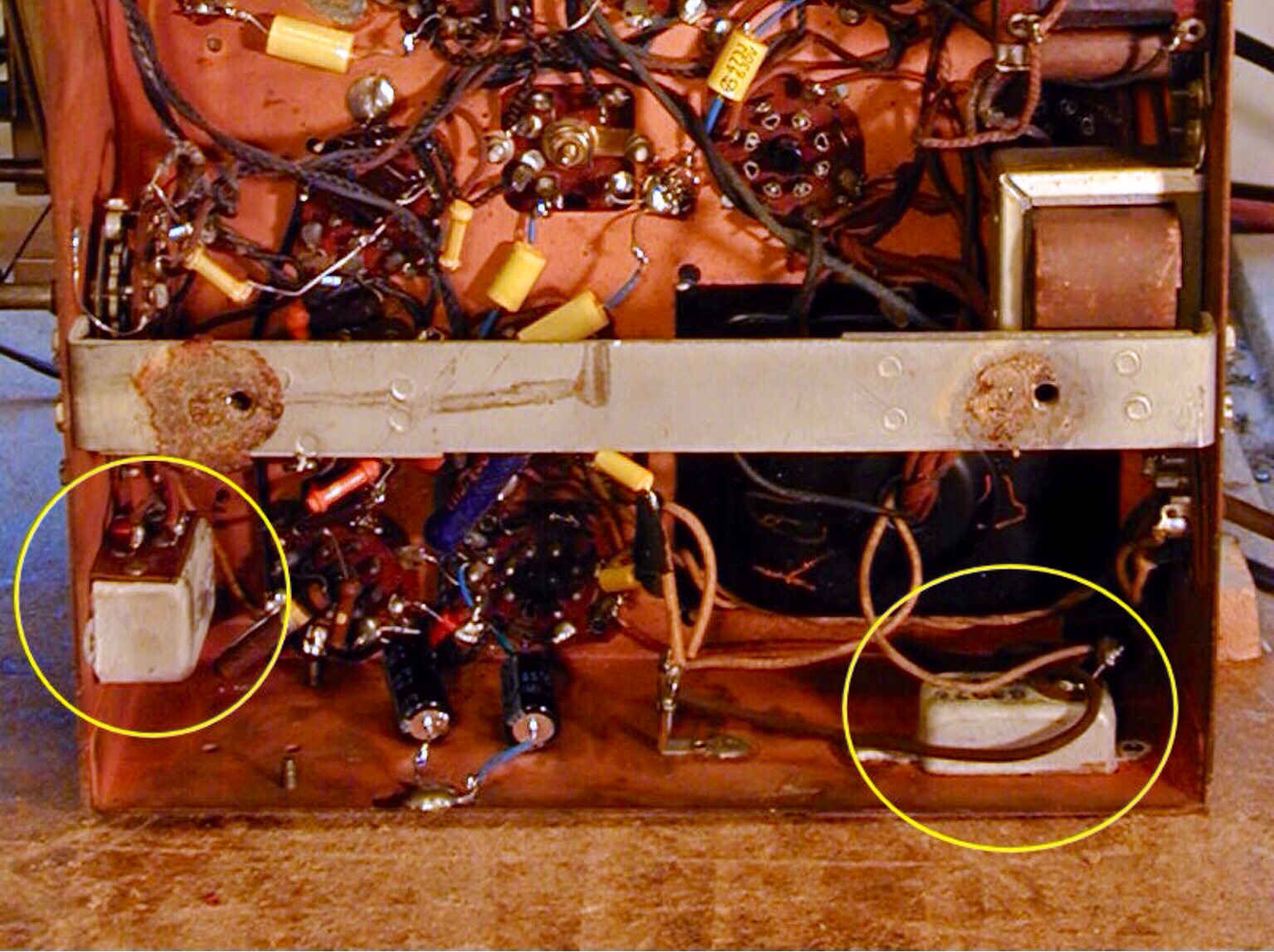
1938 Steward Warner Radio, Model 1865, with
two bathtub capacitors installed[5]
The possibility this was an Earhart artifact, while growing remote, had not entirely been ruled out. There were numerous other electrical instruments on board the Electra that undoubtedly used capacitors. More research was therefore necessary to see if specific data were available on when this capacitor was made.
The subject of this research would again be the inscription, which had, after all, provided more than simply a maker and some electrical specifications. It had also provided a part number: 630B

By fortunate coincidence, a combination of old radio part store catalogs available online, and some original Aerovox catalogs available on eBay allowed us to survey detailed product information from a representative sample of the years in which Aerovox was in business.[6]

The conclusion from this survey is that the capacitor most likely was made no earlier than circa 1947, too late for any connection to Earhart's Electra, which was lost in 1937.
1947 Aerovox Catalog

In the Aerovox catalog for 1947, there is listed a Type 630 - 600 v D.C. Capacitor. It is listed under the more general category of Type 30. Under this listing there is a .5 microfarad capacitor.

The dimensions of the 1947 Type 630 are:
Length: 1 3/4 inch
Width: 1 inch
Height: 7/8 inch

 The Nikumaroro capacitor is a .5 microfarad 600 volt D.C. capacitor, labeled "630B". Its dimensions are:
Length: 1 11/16 inch
Width: 15/16 inch
Height: 13/16 inch

All of these measurements meet the 1947 Aerovox catalog specifications to within 1/16 of an inch.

1947 Catalog page with 630 Capacitor
In examining 1930s Aerovox catalogs and numerous 1930s Aerovox advertisements, we were unable to locate any capacitor that matched the 1947 specifications.

A 1933 advertisement showed that Aerovox was then manufacturing this general type of capacitor, but in 1933 the length of the closest equivalent ran to 2 1/2 inches, much too large. In addition, at 400 volts maximum, the voltage was too low.

1933 Type 60 Capacitor

In 1935, a 600-volt bathtub Type 60 capacitor was advertised, but again the length is 2 1/2 inches and the capacitance is too low.
1935 Type 60 Capacitor

By 1945, Concord Radio Corporation advertised an Aerovox Type 630 capacitor with the correct capacitance and voltage, but at 2 1/16 inches, the length is still greater than that of the artifact.

1945 Type 630 Capacitor

There seems to have been a very brief window around 1947 when the Type 630 Aerovox capacitor was manufactured to the precise length, width, height, capacitance, voltage, and not least of all, part number, of the Nikumaroro capacitor. Only the 1947 Aerovox catalog listing matches all six of these specifications.

To a fair degree of certainty, then, we can assign the date of manufacture of the Nikumaroro capacitor to about the year 1947, perhaps a little earlier or a little later. Even if documentation were to surface, showing that a handful of 630B capacitors with the specifications of the artifact were made in the 1930s, that still would not help to distinguish this artifact from those we know were made in the 1940s.

Loose Ends

There are, however, still a few unanswered questions about this artifact. If the capacitor did not come from the 1930s, as it almost assuredly did not, then who brought it to the island, and why? Its most logical origin and function would seem to have been as a component in the radar equipment from the Coast Guard Loran station, active from 1944 to 1946.

Additional research indicates that this hypothesis, too, may be flawed. We noticed that Concord Radio Corporation's 1945 catalog listed, distinct from the Type 630 capacitor, several "Commercial Grade Capacitors... used by the Army, Navy and commercial communication companies."  None of these bears any resemblance to the artifact. The 1947 Aerovox catalog lists "High-Voltage Transmitter Type D.C. Capacitors" that were specifically made for transmitting, as opposed to just receiving. These are exactly the type of capacitors that would be ideal for a Loran station.
1947 High Voltage Aerovox Capacitor

The bathtub style of capacitor, by contrast, seems to have been manufactured for use in commercially available shortwave radios (see the Stewart Warner example, in the above photo). The Nikumaroro capacitor, therefore, seems most likely to have been something found in someone's personal radio set, not in a commercial-grade installation for the Coast Guard.

The Coast Guard Loran station was dismantled and abandoned in 1946. While it could be that someone from the newly arrived Loran cleanup crew left a personal shortwave radio with brand new capacitors on the island, there are a few other possibilities.

In an email exchange, Tom King commented:

"There were American connections to the Phoenix Islands after the War, right up to the time of the colony's abandonment. There were American anthropologists who studied some of the colonies and their end-times.. I also don't know when the operation on Canton closed down; it may have been '48 or '49 or even later. So I suspect that there were plenty of post-Coastie opportunities for the Aerovox to have gotten there. Well, maybe not 'plenty,' but 'some,' anyhow."

One final mystery is: what does the "B" in 630B stand for? From information supplied by the 1966 Aerovox catalog, it would seem that the letter B signifies that the capacitor terminals were located on the hermetically sealed bottom side. This would make sense. Since the bottom side is mostly absent from the artifact, as are the terminals, and since all bathtub capacitors we have seen had terminals, the logical position for them to have been located was on the missing bottom side.[7]

What We Learned

There are numerous odd artifacts on Nikumaroro, many of them lying on the ground in plain sight. The Zimmerman Object, found close to the capacitor and discussed in Tom King's article below, is a perfect example. The capacitor is another. Most of these artifacts could be anything from anywhere, but unless we collect, catalog and investigate them we will never know. Even after analysis is complete, we may still never know. The effort to run these to ground, what Richard Feynman called "the joy of figuring things out," can still be rewarding, even when the end of all our searching is to say that this capacitor does not show anything one way or the other about the hypothesis of what happened to Amelia Earhart.

The process of "finding out" is a useful training ground in itself for the analysis of future artifacts. At least, it was for me as I look back with fond memories on my visit to Nikumaroro in 2015.


[1] International System of Units (SI), French Système Internationale d’Unités,  international decimal system of weights and measures derived from and extending the metric system of units. Adopted by the 11th General Conference on Weights and Measures in 1960, it is abbreviated SI in all languages.
[2] Decisions and Orders of the National Labor Relations Board, Volume 28, 1941.
[3] Wikipedia article on AVX.
[5] See http://antiqueradio.org/StewartWarner1865Radio.htm
[6] The archive of Allied Radio and Electronics Corporation proved especially helpful in this regard. A nearly complete set of catalogs for this company may be found online at http://www.alliedcatalogs.com/catalogs_main.
[7] Since all Aerovox electrolytic capacitors were hermetically sealed, the bottom should have survived. It is possible this bottom portion was cut away by some curious colonist (or by someone else) at some point in the island's British colonial period. When the bottom portion was removed, it probably released into the Nikumaroro environment a small amount of toxic substances known as PCBs (polychlorinated biphenyls).
See http://www.solacanada.com/UserFiles/File/PCB23_e2.pdf  for the relationship between old capacitors and PCBs. See www.southcoasttoday.com/article/20110331/NEWS/103310343 for efforts to demolish the Aerovox plant and decontaminate the site where it once stood.

[

Monday, September 7, 2015

What is the Zimmerman Object?

Introduction

During the TIGHAR/Betchart Expeditions 2015 visit to Nikumaroro, TIGHAR member and Fiji Princess passenger Dr. Kimberly Zimmerman, along with several other project participants, came upon a metal box (Figure 1) in the feral coconut bush north of the “Gallagher Highway” (the pathway we cut on each visit from the landing to the lagoon beach at “Club Fred”). It was in a substantial cluster of historic material that included a sewing machine, an AEROVOX 630B R11 capacitor (collected and being studied by Joe Cerniglia), an enamel washpan, and several bottles.

Figure 1: Zimmerman Object in the wild

We had actually recorded the box before, at least as early as 1997 (Figure 2). On previous visits we had elected not to collect it, judging that it was almost certainly not from Amelia Earhart’s Electra 10E, but this time Dr. Zimmerman insisted that we do so, and was persuasive. So, calling it the “Zimmerman Object” (ZO) in her honor, we brought it back for identification and analysis.

Figure 2: 1997 Image of Zimmerman Object (upper center) in its artifact cluster

If the ZO turns out to be from the Electra, the joke will certainly be on us, since we have been walking past and scorning it for at least the last 18 years.

Physical Description

So what is it? Well, we don’t know, but here are its vital statistics as recorded immediately after its collection:

  • Subrectangular box, does not attract a magnet. Greenish patina suggests copper or a copper alloy.
  • Dimensions: Approximately 53 cm. (21”) by 45 cm. (17.7”) by 30.5 cm (12”).
  • Thickness of metal sheet: ca. 1.2 mm. (0.047”)
  • Four parts (one of them missing; see Figure 3)
Part A: A long rectangular sheet. Starting at point x on Figure 3, forms side A1, then was bent at a right angle at point y to create side A2. It was then bent at approximately 100 degree angle at point z to form side A3, which describes a gentle curve in the direction of point x  but is terminated at about 36 cm (14.17”). Part A forms the bulk of the artifact.

Parts (and Sides) B and C: Two side pieces, each with two straight edges and one curved edge.

Part (and Side) D (hypothetical, missing): Rectangular sheet about 31x45 cm  (12.2x17.7” ), closing the gap between the two ends of Part A.

Figure 3: Schematic of Zimmerman Object Sides


The parts were attached to one another by folding the edges of Parts (Sides) B and C over the bent-over edges of Part A, as diagrammed in Figure 4. Corners exhibit additional folded-over flanges (Figure 5). The connections between sides are not welded, but show spots of what may be solder.  A tiny fragment of fabric caught in the fold on side A2 (Figure 6) may indicate that there was some kind of gasket embedded in the folds, but if so it is apparent nowhere else on the artifact.


Figure 4: Schematics of connections between parts

Part B has become detached from Parts A and C, but was collected.


Figure 5: Corner of Side A2


Figure 6: Fabric in fold, Side A2
(Above 10 cm. mark)

  • Weight of Parts A & C: 3.81 kg (8.4 lb)
  • Weight of detached Part B: 1.042 kg  (2.3 lb)
Both ends of Part A exhibit folds similar to those connecting Part A with Parts B and C, so it appears that Part D was attached similarly, as diagrammed in Figure 4. Both have been pried open, presumably to remove Part D.

There is no evidence I can see that Part D was hinged on or latched to Part A. It appears to have been permanently attached.

Several of the edges exhibit cuts and tears.

Side A2, whose edge fold contains the tiny fragment of fabric, exhibits a reddish stain on both sides (Figure 7).


Figure 7: Side A2

The “Nipple”

Part C exhibits a small nipple on its interior surface, and a matching scar on its exterior. It appears that the nipple represents solder applied from the outside to fill a small hole, with its exterior surface then filed(?) flat, then covered with a rectangular object now missing (Figures 8, 9, 10).  The hole through which the solder extrudes (into the interior) is about  9.44 mm. in diameter, with ragged edges, distorted by being pushed in somewhat from the outside. The nipple of solder has a sort of “core” that might be small wire or plug, 3.5 mm. in diameter.

Part B, which otherwise matches Part C in every particular, does not exhibit a matching nipple.


Figure 8: Exterior overview Part (Side) C


Figure 9: Interior detail, Part (Side) C nipple


Figure 10: Exterior detail, Part (Side) C scar

Bob Draper, who with others identified the ZO’s metal as copper, pointed out that a common way to vacuum seal cans in the late 19th century was to draw air out through a tiny hole in the base which was then quickly filled with solder, creating marks very much like those on the ZO. This may or may not mean that the ZO was vacuum sealed, but it at least suggests that it had a small hole in the middle of Side C, which someone filled with solder and covered.

I can see no other distinguishing marks or attachments[1] – specifically:

  • No part numbers or other identifiers;
  • No brackets to attach the ZO to something else; and
  • No input or outlet pipes, valves, wires, cables, etc., but these may have existed in Part D.
Volume and Density Calculations

Engineer Tom Roberts, working from weights and measurements I provided, has computed the following descriptive variables for the ZO:

  • Approximate volume of metal in Part B (based on 1.2 mm thickness): 10.9 cubic inches
  • Approximate density of the material: 0.21 pounds per cubic inch
  • Approximate volume of the entire container if complete and closed: 3452 cubic inches, 0.057 cubic meters, 2.00 cubic feet or 14.9 gallons; with adjustments taking into account crumpling and bending of the material, Tom has opined that a capacity closer to 14.5 gallons might be more accurate.
Material Composition

At my request, Sturbridge Metallurgical Services (SMS) of Sturbridge, Massachusetts tested Part B to determine its metallurgical character. I can't master getting SMS’s report loaded here, but can supply it upon request. In brief, SMS determined that the Zimmerman Object is made of brass.

So What Is It?

In pondering the matter and in discussions with colleagues, several possibilities have come to mind:

1. Something brought to the island for use by the colonists, or fabricated there by the talented Public Works Officer Jack Kimo Petro or someone else. But brought or fabricated for what purpose? Presumably to contain something, but what? Why the curved side? And why is there no opening, fill port, or outlet – unless, of course, there was such a thing in Part D? Or perhaps there WAS no Part D, but why were the bent-over edges of Part A bordering the Part D gap pried open if there was no attached Part D to remove?

2. Something salvaged from the Norwich City wreck. This seems most likely, particularly since brass construction is relatively common in ships of the period, though it raises the same questions as above.

3. Something salvaged from the Loran Station[2]. This possibility raises the same questions as above, plus at least one other: if it was some item of military technology, why are there no identifying marks? No inscribed serial number, no stenciled label, nothing.

4. Joe Cerniglia, looking at the curved side of the object, suggested that it might have been designed to sit on a shelf in a Quonset Hut, several of which were built at the Loran Station. This is an attractive proposition, but if it is correct, it would place Part D, or the Part D opening, up against the side/roof of the hut, completely frustrating any access to the object’s interior.


5. Something from an airplane. The ZO’s shape tempts one to imagine it as a rigid removable fuel or oil tank (See https://en.wikipedia.org/wiki/Aircraft_fuel_tanks) designed to ride inside a compatibly shaped compartment (e.g. locations 75 or 72 in an aircraft similar to the one shownh in Figure 11).


Figure 11: Internal Structure of a Lockheed Electra 12

However, the ZO seems heavy for aircraft use; and if it was an aircraft fuel tank, the aircraft involved was almost certainly not Earhart's Lockheed Electra 10E. We have no record of a ca. 14.5 gallon fuel or oil tank in the Electra (Two 16-gallon wing tanks are reported), and no record of brass tanks or similar structures anywhere in the Electra’s construction.

6. Flotsam: something washed ashore from elsewhere, perhaps a passing ship, which opens a world of possibilities.

At this point – particularly as a non-airplane guy – I can only speculate; I tend to lean toward options 2 and 6 above. The ideas and criticisms of my colleagues (and anyone else) will be gratefully received.

Tom King


[1] A circular pattern that has appeared on Part B since it was brought to the U.S. is my fault. Apparently while the part was lying on a table I let something be set on top of it that dissolved the patina in a mirror-image pattern of whatever was on the bottom of the “something” thus set. The fact that the pattern includes the reversed letters “A” and “E” is understood to be fortuitous.
[2] Greg George has suggested the possibility that the ZO is a Faraday Cage, used to isolate a critical radio component from electrical or radio interference.


Wednesday, July 8, 2015

Reflections on the 2015 Betchart/TIGHAR Visit to Nikumaroro


On June 18 through July 2, 2015, I was privileged to participate in the Betchart Expeditions/TIGHAR tour of Nikumaroro (by way of Rotuma and Funafuti, and with sponsorship by the Planetary Society, AAAS, and Sigma Xi). Betchart’s Bob Nanson was the tour coordinator, and CEO Margaret Betchart oversaw the whole shebang. We were ably assisted by TIGHAR researchers Art and Janis Carty, Tom Roberts, Dawn Johnson, Joe Cerniglia, and for a time Barb Norris (who got desperately sick early in the voyage and had to be evacuated, but seems to be OK now), as well as by Frank Thomas of the University of the South Pacific and Jaime Bach, a PhD candidate at the University of Montana who did her MA thesis on Kiribati. We had 61 passengers from the U.S., Australia, the U.K, and elsewhere, and traveled aboard the MV Fiji Princess out of Port Denerou, Fiji. The trip was coordinated with TIGHAR’s Niku VIII expedition, but we had only a day and a half of overlap on the island with the TIGHAR team.

I’ll admit to having been rather terrified by the trip’s prospects; it was the first large tour cruise that we know of to Kiribati’s Phoenix Islands Protected Area (PIPA), and I had real doubts about our – and especially my – ability to get people (some of them even older and less able than I) on and off the island, which of course involves passage over a slippery, hard, sharp, surf-battered coral reef. I was also concerned about people getting lost, expiring in the heat, and experiencing other indeterminate catastrophes.

Happily we were not visited with any disasters, and had a good four days at the island. We were blessed with relatively calm weather, good management by Betchart, and excellent support by the officers and crew of Fiji Princess. As a result, I think we were able to give the passengers a pretty good trip, and introduced them pretty thoroughly to the island and to TIGHAR’s Nikumaroro Hypothesis on the 1937 disappearance of Amelia Earhart and Fred Noonan.

Contributing to our ongoing work to test that hypothesis, we accomplished several pieces of work:

1. We found what appears to have been a warehouse for the Nikumaroro colony’s Cooperative Store, wherein we found, of all things, what appear to be perfume bottles and French perfumed soap jars. This suggests that the colonists, rather than Earhart, might have been responsible for the cosmetic products we’ve found at the Seven Site – something we knew in the abstract, but for which we’d heretofore had no evidence.

2. We cleared and searched a 15x15 meter plot east of the Cooperative Store, finding two more aluminum hair combs (one very fancy) and a teakettle out of which metal had been cut to produce tabular blanks that could be made into things like combs. This demonstrated that an airplane was not the only plausible source of such raw materials.

3. Biologist Rachel King (my older daughter, say I proudly) did a quick but thorough look for edible and poisonous plants, found a fair number of the former and none of the latter. This helps flesh out the story of Earhart-on-Nikumaroro, assuming she was there.

4. Betchart naturalist Bob Nanson looked over the fauna and provided some useful insights into (particularly) how Earhart might have lived off marine and avian resources, notably bird eggs.

5. TIGHAR’s Tom Roberts and a doughty crew loaned by the Fiji Princess hacked their way into the Seven Site to assess its current condition and let the passengers see where we think it likely that Earhart died.

6. TIGHAR’s Dawn Johnson collected samples for use in testing the efficacy of forensic dogs in identifying bones on the island.

7. TIGHAR member and Michigan State Representative Larry Inman and a small but enthusiastic team waded through shoe-sucking bird poop to visit a lagoon beach we called the Inman Site (because Larry identified it on TIGHAR’s Aerial Tour of Nikumaroro as a candidate castaway campsite) and then hacked on across the island to the sea in about half an hour. Our ability to do so suggests that had someone walking down the windward beach wanted to, she or he could have accessed the lagoon pretty easily. We found no evidence of a campsite, but on the ocean side we did find the low-tide reef flat totally covered in sea cucumbers – a hitherto unknown possible castaway food source.

8. Quite a few divers, snorklers, and a glass-bottomed boat scanned the reef in the neighborhood of the putative Earhart landing site, with negative results – but as one of my wiser colleagues once said, negative data are positive data.

9. We brought back a number of artifacts from the colonial village for analysis – the cosmetic containers, the combs, and some possible if unlikely airplane parts. We’ll see what they have to tell us; at the very least they’ll enrich our understanding of the village and the role played by aluminum (aircraft-derived and other) in the lifeways of its residents.

All in all, I’d call the trip a successful venture. I’m grateful to the Republic of Kiribati for permitting it, to Kiribati on-board representative Nina Jacob for facilitating it, to Betchart Expeditions for making it happen, to Dawn, Tom, Barb, and the other TIGHARs who worked tirelessly to oversee and handle the details, and to all the participants who put up with high seas and my boring lectures in order to take part..


Oh crap; they're back!  Kiakia (fairy terns) watch our arrival on Niku. Photo by Joe Cerniglia

Monday, June 1, 2015

Ready to Launch

TIGHAR's Niku VIII Expedition will soon be underway aboard our faithful expedition ship Nai'a, sailing out of Fiji for a three-week trip to the island. There the team will deploy an ROV to examine previously identified anomalies on the reef face, while divers do systematic sweeps of the divable reef below the location of the famous "Bevington Object" (aka "Nessie"), and a shore party under Gary Quigg's supervision examines the area where Art Carty hypothesizes that Earhart and Noonan might have had their "Camp Zero." Full details on the TIGHAR website.

I'm sorry to not be sailing with Nai'a, but I'll be following close behind aboard Fiji Princess, with TIGHARs including Dawn Johnson, Barb Norris, Tom Roberts, Art and Janis Carty, and Joe Cerniglia, plus some 60 guests of Betchart Expeditions (http://betchartexpeditions.com/). We'll arrive a couple of days before Nai'a sets sail for Fiji, and will follow up on whatever the TIGHAR team has done plus checking a few anomalies identified in aerial and satellite imagery.

Due to a last-minute cancellation, we have one available cabin aboard the Princess; if you'd like to join us, contact Betchart Expeditions via their website. We sail from Fiji on June 19th, returning July 2nd.

Fiji Princess

Thanks to Mike Campbell

I’m grateful to Mike Campbell for posting an image of a ferrous metal fragment from Mili Atoll in the Marshall Islands (https://earharttruth.wordpress.com/tag/saipan/ [scroll down to August 22, 2014]). Mike – following the lead of its discoverer, Oliver Knaggs -- thinks it represents a “silver (colored) container” that he says Ralph Middle says that fishermen Lijon and Jororo said they saw in the hands of a pair of aviators, male and female, who – they are said to have said – landed at Mili and were captured by the Japanese in 1937. He concludes that the male flyer was Fred Noonan, and that the box may have been the one Amelia Earhart reported that Noonan acquired in Africa en route to New Guinea and the pair’s date with destiny over the Pacific.

What I find interesting is that Mike’s (that is, Knagg’s) fragment looks a lot like a collection of tiny ferrous fragments we’ve recovered from the SL fire feature at the Seven Site on Nikumaroro. They’re similar in that both the Mili artifact and those from Nikumaroro have these funny little bumps on them. In the case of Mike’s artifact, the bumps are obviously the heads of connectors (probably rivets of some kind) that held a hinge to the body of the metal box. I’d suspected this in the case of the bumpy ferrous pieces from the SL Feature, and Mike’s image makes me much more confident of my interpretation.

The Mili artifact, though, seems to represent a box with a couple of discrete hinges. We have far too many pieces of bumpy ferrous in the SL Feature to represent that kind of hinge arrangement.  But it also looks like our bumps are a lot smaller than Mike’s (It’s hard to be sure, since he doesn’t include a scale in his image). So maybe our box had a single hinge that extended the length of one side, and was riveted multiple times with very small rivets.


Above: example of metal fragment with apparent rivet, SL Feature, Seven Site. Millimeter scale

Some of our ferrous fragments also have very thin wires embedded in them, between ferrous lamellae. This has been puzzling, but as I think about the possibility of a hinged box, I’m imagining some kind of spring-loaded self-opening or closing hinge featuring a thin wire or wires coiled along the length of the hinge with opposing right-angle bends at the two ends. It’s a possibility, anyhow.

There’s no particular reason to think that Mike’s artifact or our many metal fragments have anything to do with Earhart and Noonan . Mili was heavily occupied and built up during the Japanese administration, so there are lots of possible sources for Mike’s fragment. Nikumaroro’s colonists or Coast Guardsmen could have been responsible for the metal we’ve found. Because the Seven Site has produced so many suggestive artifacts, though – the probable compact, the probable freckle crème jar, the various bottles, the jackknife, the buttons and zipper pull, for instance – we want to understand everything we’ve found there. Mike’s post may help us understand our metal fragments, and I’m grateful for that. 


Friday, January 9, 2015

Electra-fying Discoveries on Mili Atoll?

I'm grateful to my old friend Ward Upson, of Vancouver, Washington, for sending me a clipping from the Columbian newspaper, dated January 2 of this year; it's titled “Washington Men Unearth Potential Earhart Clues[1].”  The article reports that Dick Spink of Bow, Washington has brought home a piece of aluminum from Mili Atoll in the Republic of the Marshall Islands (RMI) that he and his friend Jim Hayton are sure is a dust cover from one of the air wheels on Amelia Earhart’s Lockheed Electra.  He also has a piece of aluminum that he and Mr. Hayton think was an inspection plate from the leading edge of one of the Electra’s wings.

Why am I not impressed?

Proponents of the hypothesis that Earhart landed in the Marshalls and was captured by the Japanese will tell you it’s because I’m a part of the great U.S. government conspiracy to cover up the truth about Earhart[2].  For the life of me, however, I can’t recall being enlisted in this conspiracy, and I do have other reasons for my skepticism.

Inferring things (like “Earhart landed in the Marshalls”) from artifacts (like pieces of aluminum) is what archaeologists like me are trained to do.  Over the last 150 years or so we’ve developed a pretty standard set of methods for documenting what we find in such a way as to make our inferences reasonably reliable.  Not 100% reliable, but as reliable as we can make them given the circumstances under which we work.  The key concept underlying our methods involves the importance of context.  Where was each thing found, what was nearby, what sort of soil or sand was it lying in, how deeply was it buried, and so on.  We go to quite a bit of trouble to record all this sort of data, and we do it for the same reason a crime scene investigator prepares detailed records on a crime scene – because these data tell the artifact’s story.  They can inform us about how the artifact came to be where it was found, maybe with what other things it was used, sometimes even who used it – all of which can give us clues as to what the artifact is and what it means.  So we make careful maps of the sites we investigate; we plot what we find on and in them, and we take lots of notes and photographs as we go along, constructing as complete a record as we can of everything we did, everything we observed, everything we inferred.  Many times all these data turn out to be useless, but if we didn’t collect them, we wouldn't collect those bits of data that turn out actually to be important.  It can be tedious and boring, but those are the methods we use, and the reason for using them.  Without them, we're just picking stuff up and speculating about it.

As far as I can tell, Mr. Spink didn’t use such methods.  According to the Columbian, his team of searchers “used metal detectors, shovels and picks to sweep the beach.”  Then – and the Columbian quotes Mr. Spink on this – “(e)verybody brought back what they found and put it in a pile.”  Exactly what happened to the piles is not clear; Mr. Spink simply says that he “did more research, did more interviews, people told me stories.”  Which he pursued, apparently using the same methods as before, eventually bringing home his selected pieces of aluminum.

OK, what’s wrong with this?  Well, the “sweeping the beach” part is OK – you’ve obviously got to look for stuff if you’re going to find it.  But what’s missing in Mr. Spink’s account of his methods is any evidence of sensitivity to context, any effort to record where things were found, and under what circumstances.  You sweep, you find, you pick up and you put everything in a pile.

Piffle, you say, why should Mr. Spink have adhered to your archaeological methods?  He’s not an archaeologist.

True, he’s not; he’s identified by the Columbian as the founder of Dynatrax, an aluminum boat kit manufacturer.  His colleague Mr. Hayton is an aircraft restorer licensed by the Federal Aviation Administration to inspect airplanes and approve them for flight.  Honorable professions, which certainly don’t demand archaeological training or experience.

But on Mili Mr. Spink was not practicing his profession; he was looking for artifacts from which to make inferences about Earhart’s fate – that is, he was doing archaeology.  He just seems to have been doing a very poor job of it.  Incidentally, the RMI government has pretty extensive laws and regulations governing the conduct of archaeological investigations, and I’m reliably informed that Mr. Spink ignored and violated them. 

Let’s not dwell on legalities, though.  The main thing is that Mr. Spink’s methods -- as described -- give us no basis for believing in what he says he found.  He sent his team out to sweep the beach; they brought back what they found and put it in a pile, and – well, that’s it.  If someone actually did find a piece of an Electra and dump it in the pile, we have no way of knowing where it came from, what it was associated with, or anything else about its context.  In truth, we have only Mr. Spink’s word for the notion that it even was found on Mili.

There are other problems with Mr. Spink’s research, most of which have been identified by members of TIGHAR’s Earhart Search Forum and summarized for me by Ric Gillespie.  For one thing, before World War II the Japanese built dozens of Model 14 “Super-Electras” under contract, and used them throughout the war for things like VIP transport.  So finding a piece of an Electra on Mili doesn’t mean you’ve found Earhart’s plane.  For another, Earhart’s airwheels apparently didn’t have dust covers; there are plenty of pictures of Earhart’s plane during the World Flight, and dust covers appear in none of them.  As for the presumed inspection plate, Mr. Hayton infers that it’s from Earhart’s plane because of its “period-and-usage-correct yellow zinc-chromate primer applied to either side of the piece.”  According to Gillespie and other experts, zinc chromate primer is actually associated with World War II military aircraft, not with pre-War civilian aircraft.  In our work on Nikumaroro, when we find a piece that’s thus primed, we take the primer to disqualify the object as an Earhart association.  Mr. Hayton also notes that the “inspection plate” is painted red, like the trim on Earhart’s plane.  Well, OK – though Earhart’s trim was actually orange – but it’s just possible that another airplane or two in the Marshalls had red trim.  And according to Gillespie, who’s examined just about every Electra 10 in captivity, there are and were no inspection plates on the wings' leading edges[3].

The main thing for me, though, is that by sending folks out to pick stuff up and put it in a pile, it seems to me that Mr. Spink rather systematically discredited his own research.  We have nothing but his unsubstantiated word to rely on – no maps, no photos, no measurements.  For all we know, his Electra-parts (if that’s what they are) could have come from Omaha.

Archaeological field methods were developed in order to give us something beyond the mere unsubstantiated word of an investigator as a basis for interpreting what’s found.  Substantiation of observations is the reason for such methods, and the reason they’re specified in standards like the regulations of the RMI (which also specify, for the same reason, that trained archaeologists oversee fieldwork).  When an investigator declines to use such methods, and doesn’t even explain why he declined, there is simply no reason to give his conclusions any credence.

Of course, maybe I’m ill-informed.  Maybe Mr. Spink did use archaeological methods, and did keep appropriate records; maybe this fact just didn’t make it into the Columbian piece or any other report I've seen on his work.  If so, I hope someone will let me know.  I’d love to see Mr. Spink’s full report.


[1] The Columbian, 1/2/15, page C4, Clark County, Washington; see http://www.columbian.com/news/2015/jan/02/washington-men-unearth-potential-earhart-clues/
[2] C.f. Mike Campbell: Amelia Earhart – the Truth at Last; http://earharttruth.com/ -- but you might also want to review http://tighar.org/Projects/Earhart/Archives/Research/ResearchPapers/AEinMarianas.html .

Sunday, October 12, 2014

Bead-dazzled

This little (very little – the scale is in millimeters) red bead was found in 2010 at the Seven Site, a bit upslope from the SL- fire feature.  We’re in the process of determining what it’s made of (I think glass; others thing maybe other things), and are consulting with bead experts about where it might have come from, but I thought I’d put it up here so readers can speculate on it. 


It’s the only such item of ornamentation to be found at the site, but there very likely were more.  It’s much smaller than the size of the coral rubble that makes up the site, so items like it may well have filtered down through the rubble to much greater depths than we’ve probed.  It’s also smaller than the gauge of our screens; as Ric says, it’s remarkable our team even found it.  The penny was not found at the Seven Site, but reminds us that we're deep into fundraising for the 2015 Niku VIII expedition -- hint, hint....