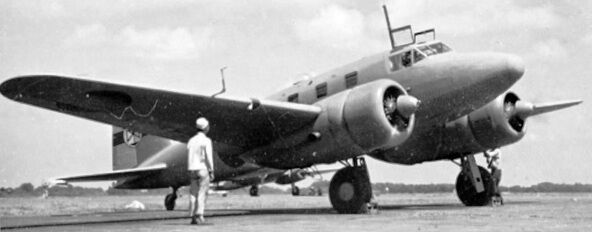
Guessing Toward Land
Members of TIGHAR (The International Group for Historic Aircraft Recovery) have often pondered the sixth possibility: that the airplane sank in very shallow water, close to the shore but just deep enough to be at most times invisible. In the high-energy environment close to the island’s fringing coral reef, cyclones and lesser storms striking frequently during the winter months would do it great damage. All or most of the wreckage could have been swept shoreward, in stages, slowly, piecemeal, but inexorably, over the ensuing decades. Perhaps some of the smaller pieces are even now washing ashore.[6]
Anecdotal accounts, over a long time frame, lend some support to this conjecture.
- Emily Sikuli, who lived on the island from 1939 to 1941, stated she saw a large piece of an airplane on the northern shore of Nikumaroro near the wreck of the S.S. Norwich City. In an interview, when asked how large the airplane was, Emily stated, holding her arms out, "About four arm spans."[7]
- Pulekai Songivalu, who lived on the island after World War II as resident schoolmaster, stated, "I saw pieces of airplane in the lagoon."[8]
- Tapania Taiki, daughter of Pulekai Songivalu, who lived on the island from 1958 or 1959 and left in the mid 1960s, stated, "I saw a piece of airplane wing on the reef."[9]
- Between 1944 and 1945, John Park Mims (1920-2018) made many trips to Nikumaroro in a PBY from Canton to resupply the Coast Guard LORAN station stationed on the island. He stated that he witnessed a large fish having been recently caught by the islanders. The hook in the fish's mouth was, according to the islanders, made from aluminum from a downed airplane. The line leader was aircraft control cable, recognizable to Mims and to his friend, Eyvind Wahlgren, as from a type of aircraft that was smaller than a PBY.[10]
The sixth possibility, aircraft wreckage washing up on shore, is the one most consistent with anecdotal accounts, but anecdotal accounts are of limited value, because memories can change, be inaccurate or otherwise wrong. It is noteworthy, however, that the native anecdotes tend to corroborate one another and are supported by some members of the Coast Guard who visited the island as well.
There is a discarded bit of evidence, additionally, that seems as though it might be consistent with the sixth possibility, and with the anecdotal accounts. It consists of a photo, named the “wreck photo.”
The Wreck Photo, Reconsidered
The photo was in the possession of U.S. Navy Captain George Carrington. Carrington said the photo was given to him by a former British seaman who had served on the HMS Adamant. For reasons of privacy, the seaman requested anonymity. This seaman claimed that, sometime in 1946 or 1947, he and other men from the ship had gone ashore on what they took to be a deserted Pacific island, whose name escaped his recollection, for purposes of recreation and gathering sand for boiler room fires. While in back of the tree line, the sailor took the photograph of the wreck of a twin-engined airplane. Carrington brought the photo in the late 1980s to the notice of Lockheed Aircraft Corporation, which enlisted the help of the Smithsonian Air and Space Museum, and later TIGHAR, in learning more about its origins and possible significance to the mystery of Amelia Earhart’s disappearance.[11]
TIGHAR, after more than 21 years of exhaustively researching the photo, ultimately dismissed it in 2009 as a depiction of the wreckage of a Japanese Tachikawa Ki-54 on Agrighan Island. It based its identification of where the photo had been taken on the logs of the HMS Adamant, whose only recorded port of call on an island seeming to match Carrington's description in 1946-47 had been Agrighan. It based the identification of the airplane in the photo on the way the engine cowlings had come apart, which were different from how an Electra’s engine should have, and on what it claimed was the presence of a “small round inspection plate” just forward and a little rightward of the center line from the windshield, on the nose section of a surviving Tachikawa Ki-54s housed in the Beijing Aviation Museum. Both the airplane in the wreck photo and the airplane in the Beijing Aviation Museum, it claimed, carried this same inspection plate in identical locations.[12] What TIGHAR claims to be an inspection plate in photos, however, seems difficult to distinguish from what may actually be a small hole, nor is it apparent from its research that all Tachikawa Ki-54s carried an identical inspection plate, nor even that the oval-shaped spot on the photo of the Tachikawa K-54 in Beijing is an inspection plate.
Odd Attributes of the Wreck Photo
Regardless of where the photo was taken or what airplane it shows, there is something very unusual about the condition of the airplane depicted. The propeller in the aircraft engine shown is apparently unbent. When a propeller-driven aircraft crashes, either through “controlled flight into terrain” or through a loss of control in an attempted landing, propellers will be a primary area of damage. Most always they are bent. How the propellers bend can be an indication of what the airplane was doing prior to the crash. If a blade is bent forward, it indicates the airplane engine was operating at high power at the time of impact. If a blade is bent rearward, it indicates the engine was supplying little or no power, but the blades were still turning.[13]
Indeed, the Electra itself had its propellers turned significantly forward when it crashed in March, 1937 at Luke Field in Hawaii, thus indicating the engines were under full power at the time the propellers impacted the runway.[14]
A Tachikawa Ki-54 recovered from Lake Towada in Japan has its propellers turned significantly rearward.[15]
Propeller of wrecked Tachikawa Ki-54 has propeller bent rearward.
From the relatively pristine condition of the propeller blades in the wreck photo, we may infer that the significant damage sustained by this airplane, including most of the fuselage and cockpit having been ripped away from the engine, was not caused by a crash. Rather, the damage was caused subsequent to a landing.
Perhaps the damage was caused on land by a storm, or, perhaps it was caused by the airplane having been heaved up violently to the place where it was found, just inshore from the beach, by an ocean swell. Another possibility is that the airplane was fired upon in an air assault. This could also explain how it could be so severely damaged and yet escape damage to its propeller.
However, if the airplane in the photo was not attacked, it would seem that for it to sustain this kind of damage, without damage to the propellers, it must have been landed successfully and been abandoned by or lost from the control of its owner. If such an abandonment or loss of control occurred, this would seem to have been a very unusual event, highly atypical of most aircraft incidents or crashes. It is, however, exactly the scenario envisioned by TIGHAR for Earhart’s Electra.
Of Propellers and Their Hubs: Was the Airplane in the Photo a Tachikawa Ki-54?
Both the Earhart Electra 10e and the Tachikawa Ki-54 used variable pitch, constant-speed, non-feathering propellers. The propellers on these two airplanes, however, have one very noticeable difference. Most photos of the Tachikawa show large propeller hubs covering the area in which the blades meet.[16] The Earhart Electra 10e had no such massive propeller hub. The airplane in the wreck photo also has no such large propeller hub. Photos of wrecks of the Tachikawa show that these hubs can survive a crash, and should have remained mounted, if originally present, on the propellers in the wreck photo.
Photos of different models of the Japanese Tachikawa Ki-54 with propeller hubs in place.
This photo of a wrecked Tachikawa Ki-54 shows one propeller hub is present and one is missing. The port engine has lost its propellers and its propeller hub. Both engines show significant compression damage around the cowling, indicative of violent impacts. The surviving propeller blades on the starboard engine are bent. [17]
This photo of the Electra 10e shows no propeller hub.
All of this is not to imply that the wreck photo cannot possibly depict a Tachikawa Ki-54, or that it does depict an Electra 10e. What this re-analysis does imply, however, is that circumspection about the identity of the airplane in the photo is warranted.
Sick Trees: Could the Photo Have Been Taken on Nikumaroro?
While it would be impossible to know with certainty on which Pacific island the photo was taken, there would seem to be nothing about the photo that rules it out as having been taken on Nikumaroro. In fact, there is historical information about the colony on Nikumaroro that correlates very well with the photo itself.
Most noticeable in the background of the wreck photo are the presence of several tattered and wasting coconut trees. Only a year after the photo was said to have been taken, several telegrams to the District Officer on Canton Island express concern regarding the condition of the coconut trees on Nikumaroro. These telegrams suggest ways of coping with the difficulty, including burning Buka groves in order to rid these areas of substances “poisonous for coconuts.”[18]
The problem of maintaining the health of the coconut trees on Nikumaroro appears to have been a perennial concern up until the time the colony was abandoned. As late as 1963, the Pacific Islands Monthly related how drought conditions had killed off many of the coconut trees of the colony, resulting in the necessity of the colony’s abandonment.[19]
Sick trees on Nikumaroro in 1963, similar to those seen in the wreck photo.
Was the Photo Taken on Agrighan?
In contrast to the difficulty of keeping the coconut palms disease-free on Nikumaroro, Agrighan Island appears during the 1940s to have thrived with healthy vegetation. Commander McAfee, in his report from the search for the lost crewman of a B-29 that crashed there, described a place that was seemingly ideal for agriculture, of all types:
"Agrighan Island, although of volcanic origin, is covered for the most part by rich, black, loamy soil conducive to a heavy growth of vegetation and plant life. It is true that the greater portion of the coastline and a large section of the eastern half of the island is made up of sharp, jagged, lava rock in the form of caves, ledges and cliffs. But excluding these portions of the island, most any kind of vegetables or fruits could be produced to maintain many times the number of natives found there. There are areas on the southwestern, southern and southeastern part of the island that could easily be turned into pasture land for the maintenance of live stock (sic)."[20]
No mention is made in McAfee’s report of the types of problems with dying coconut trees that appear to have very much troubled the Nikumaroro colony.
If the wreck photo truly depicts a Tachikawa Ki-54 that crashed on Agrighan Island, none of the three aircraft that crashed on Agrighan fit that description.
A B-29 was reported lost on the northeastern side of Agrighan on April 27, 1945 [21] and the Bureau of Aircraft Accident Archives (https://baaa-acro.com) shows two aircraft accidents during the 1950s on Agrighan, occurring within days of one another.[22] On December 17, 1953, a Consolidated PB4Y-2 Privateer, conducting weather observations on Typhoon Doris, crashed somewhere off Agrighan. Three days later, a Douglas C-47 Skytrain (DC-3) took off from Andersen AFB on Guam in search of the lost crew. At some point, the airplane lost visual reckoning of its altitude, and crashed into the volcano in the center of Agrighan Island. All crew of both airplanes were lost, as was the crew of the B-29 despite a vigorous search for one member thought to have parachuted to safety.[23]
The B-29 was a four-engine bomber whose engines powered four-bladed propellers,[24] easily distinguishable from the two-bladed propellers shown in the Wreck Photo. The Douglas C-47 Skytrain was powered by three-bladed propellers.[25] The Consolidated PB4Y-2 Privateer was also powered by three-bladed propellers.[26] None of the three recorded aircraft wrecks on Agrighan have been documented in recent archaeological surveys.[27] It is, of course, not impossible that a Tachikawa Ki-54 crashed on Agrighan during World War II and was not documented, but one must needs ask what a Japanese aircraft on wartime patrol would be doing reconnoitering an island that was of limited strategic importance and that they already controlled. In 1945, Agrighan was inhabited by about 120 natives, who farmed a coconut plantation managed by four Japanese overseers.[28]
Where is the Airplane?
If Amelia Earhart’s Electra 10e really landed on Nikumaroro, was washed out to sea, then swept shoreward, in pieces large and small over the ensuing decades, as the colonists’ anecdotes, anecdotes from the U.S. Coast Guard, and, possibly, the wreck photo, all seem to imply, one may well ask: where are those pieces today?
Even if many small Electra 10e pieces may have been collected by TIGHAR in its various expeditions to the island since 1989, and even if a large piece here and there were transported from Nikumaroro to other islands, such as to Canton in the 1970s[29], this would still leave a large portion of the airplane, presumably waiting to be discovered in the scaevola of Nikumaroro or along the beach, intact.
So far, however, no large engines or wings or cockpit have emerged from the many expeditions TIGHAR members have made to the island. No smaller pieces that were both easily and uniquely identifiable to the Electra 10e have been found.[30]
The Missing Piece
Even if all the anecdotes are true, and much of the photographic and artifactual evidence collected on Nikumaroro to date indicate an Electra 10e was once there, these cannot account for a complete Electra 10e. There is a missing piece in the puzzle, and that piece is likely to be more complex than simply a remnant of an airplane.
According to Dr. Thomas King, there is much evidence in the old colonial village on Nikumaroro of colonists having been interested in quarrying aluminum for handicrafts and tools. He writes:
“Lots of aluminum, all in small pieces, usually more or less rectangular, cut from larger pieces with tin snips or maybe a machete. Some pieces were in an area more or less between the houses—marked by the remains of a stone-lined platform—and the dense charcoal and bone deposit left by the cookhouse. With one of the aluminum pieces were pieces of pearl shell and a glass bead. It looked like someone at Manybarrels had been making handcrafts with aluminum decorations.”[31]
On the other hand, this interest seems to have been greatly tempered and restrained by a kind of superstition that anything to do with the airplane was haunted and, thus, dangerous and forbidden. Tapania Taiki, daughter of the schoolmaster on Nikumaroro, who lived on Nikumaroro from the late 1950s to the early 1960s, stated in a 1997 interview:
“The older people said they saw the skeletons of a man and a woman, one each. The elders said ‘Do not go to where the plane is, there are ghosts there.’ They were trying to scare us to keep us away from there.”[32]
It is difficult to imagine or explain the reasons behind this combined fascination with and prohibition against airplane wreckage that colonists reported having seen on the island. Nevertheless, no matter the motivations for doing so, the elder colonists appear to have processed and transmuted significant amounts of aircraft aluminum, and other pieces of equipment from some complex machinery, for their own purposes.
We see possible evidence of this transmutation in the debris of the old carpenter shop. There, the remains of an old workbench or storage cabinet is piled high with circular bearing sleeves, cables of various gauges, and metal tubes. Some of these items have been marked with orange and pink archaeological flagging tape from previous expeditions to the island.
An Entirely Speculative Observation
Could it be that the colonists had an interest in airplane wreckage that included more than simply tools and handcrafts? Quite apparently, at least a few were amply able to overcome their superstitions and fears at approaching what they saw. Were they attempting to reduce the amount of wreckage on the island in order to avoid too much disruptive inquisitiveness from outsiders as to whence this wreckage had come? If so, how much of this airplane wreckage the younger colonists reported having been warned against was reduced by the elders of the village to pieces too small to invite investigation by the island’s colonial administration or by the world beyond? Such speculation raises many questions. The passage of some 56 years since the colony was abandoned renders it unlikely that anyone now living can provide an answer that would neatly tie everything together.
We are left, however, with a few simple facts:
- Ballard and his team searched the waters around Nikumaroro extensively to a depth of some 900 meters and to a distance more than a mile from shore. No obvious signs of an aircraft were spotted.
- Pieces of aircraft wreckage were reported by colonists at various times near or on the northern part of the island.
- These reports were echoed by reports from two supply personnel for the U.S. Coast Guard station on the island.
- A British seaman reported, and took a photo of, his 1946/1947 discovery of a radial aircraft engine and other pieces of obvious aircraft wreckage on what he took to be a deserted island in the Pacific.
If these reports or even some of them actually happened on Nikumaroro, then the best and perhaps the only place to look for what small remnants of Earhart’s Electra 10e might remain is in the land areas of the island where wreckage was reported, both in the village and on Nutiran.
Whither Bound?
And the end of all our exploring
Will be to arrive where we started
And know the place for the first time.
- T.S. Eliot
In the final analysis, this essay should not be construed as an exhortation to revive old arguments, such as the one that swirled around the wreck photo 10, 20 and 30 years ago. It is highly doubtful the wreck photo can ever be definitively identified as a certain aircraft on a certain island.[33]
This essay should be construed as an exhortation to acknowledge that something different, perhaps very different, happened on the reef with the airplane than what those who have considered it have traditionally been willing to acknowledge.
That acknowledgement for some could mean an airplane that was never on Nikumaroro. But for those who still consider the evidence, the acknowledgement might productively involve investigating new approaches (water-penetrating LIDAR, for example, if such a thing has existed, or will exist), and - perhaps - revisiting some old approaches, by way of some old, discarded evidence, such as devoting some of the resources in time and money to the village and Nutiran that have up to now been poured into the ocean.
Such an effort would not be wasted. We would learn much more than we do about the life ways of a hardy and indomitable people, the colonial village denizens of Nikumaroro. In the process, we might also find an artifact, or two, that tells us more about the fate of a hardy and indomitable explorer who unwittingly may have found herself unrescued on this beautiful but forbidding place the islanders called home.
Remains of the workbench or cabinet from the carpenter's workshop. Photos by Joe Cerniglia from the 2017 Nikumaroro expedition.
=====================
I am indebted to Pacific historian Scott Russell for providing me with the U.S. Navy's 1945 report on the Agrighan search and rescue operation for the crashed B-29.
This paper is dedicated to the memory of Lt. Col. Northrop, USAAF, missing flyer from the B-29 that crashed on Agrighan on the morning of 27 April, 1945.
___________________
Endnotes
[3] For a through treatment of the “float-away” hypothesis, see Meeds, Sherman. No Place to Put a Stone: An Analysis of the Facts Concerning the Disappearance of Amelia Earhart and Fred Noonan. Author: 2012, p. 222.
Accessed 1 November, 2019.
Accessed 1 September, 2019.
[6] Additional artifact updates from trips to Nikumaroro in 2015 and 2017 are forthcoming.
Accessed 1 September, 2019.
[8] Songivalu, Pulekai. Interview by Kenton Spading and Richard Gillespie, TIGHAR. 22 March, 1997, TIGHAR Tracks, Vol. 13, #1, pp. 9-10.
[9] Ibid., p. 11.
[10] TIGHAR Tracks, Vol 11, #3, pp. 12-13.
Accessed 2 November, 2019.
[13] Handbook for Aircraft Accident Investigators. (U.S. Naval Aviation Center, 1961), p. 34.
Accessed 2 September, 2019.
[20] McAfee, Robert, Commander, USNR. May 7, 1945. Report by U.S.S. Currier on Agrighan Island Search and Rescue Operation (Report DE 700-TE/A16-3 Serial 001), p. 3. Received by Fleet Post Office, San Francisco, CA.
[21] McAfee, Report by U.S.S. Currier on Agrighan Island Search and Rescue Operation. p. 1.
[23] McAfee, Report by U.S.S. Currier on Agrighan Island Search and Rescue Operation. p. 3.
[27] King, Thomas. “Re: The engine on the reef.” Message to Joe Cerniglia. 8 September, 2019. E-mail.
[28] McAfee, Report by U.S.S. Currier on Agrighan Island Search and Rescue Operation. p. 4.
[29] Bruce Yoho stated that while visiting an island in the Phoenix Group in 1970 he spotted a single-row radial engine on its reef. He persuaded his helicopter pilot to fly the engine as a “sling load” back to his base on Canton. While other servicemen remembered the “engine in the shop” while on Canton, and were able to offer various opinions on what the model of the engine may have been, none remember recovering the engine from another island. The story lacks corroborative documentary evidence and supporting anecdotes. It is mentioned here only because it could, if true, help explain why nothing so obvious as a large radial engine has been found on Nikumaroro. It would, however, require the assembly of an intricate timeline or rationale to explain why, if the engine was from Nikumaroro, no colonists reported seeing such a thing, either. The story does, however, eerily correlate with the 1946-47 wreck photo, which depicts a single radial engine, and which also leaves unanswered the question of why such an engine, if from Nikumaroro, went unreported.
See Thomas F. King, Randall S. Jacobson, Karen Ramey Burns, Kenton Spading. Amelia Earhart’s Shoes: Is the Mystery Solved? Lanham, MD: Altamira Press, 2001, p. 196.
Special thanks are owed to Arthur Rypinski for his research interviewing Bruce Yoho and other servicemen who served in the U.S. Air Force on Canton in the 1970s.
Rypinski, Arthur. (2003). Lost Engines of the Pacific: The Canton Island Mysteries. Presentation to Earhart Project Advisory Group, Wilmington, Delaware, August 16, 2003.
[31] King, et al. Amelia Earhart’s Shoes. p. 173.
[32] TIGHAR Tracks, Vol 13, #1, p. 11.
[33] The wreck photo was, however, considered very seriously as a possible Electra 10e for a number of years. See